
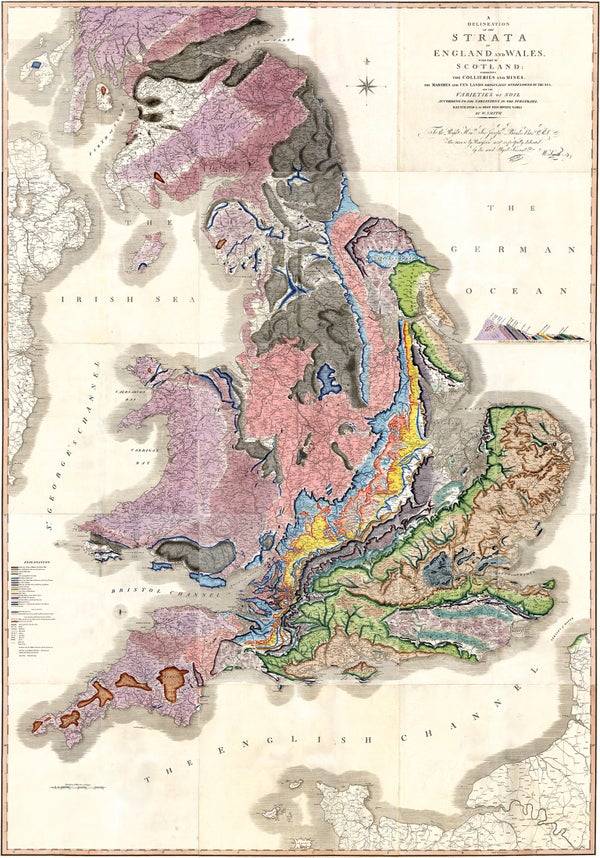
Strata: William Smith’s Geological Maps
edited by the Oxford University Museum of Natural History
University of Chicago Press, 2020 ($65)
Strata are the ribboned horizontal layers of minerals and sediment that underlie the topography of all the landmasses on the earth and have been revealed by erosion over hundreds of millions of years. Although the practice of mapping geologic layers had begun in the mid-17th century, the science of how strata formed was still nascent. By the late 1700s self-made land surveyor-cum-geologist William Smith brought new breadth and perspective to the study in his work for a mining and prospecting firm. Captured in the many maps and sketches in this stunning collection, the fossils he systematically tagged to particular geologic strata paved the way for a more holistic view of geology that enabled other researchers and industrialists to predict the geologic makeup of large regions. Perhaps the culmination of this pioneering work is Smith’s Technicolor map of Britain’s geologic deposits, which he labeled with the colloquial names used by miners and quarrymen of the day: Red Marl colored in peach pink, London Clay in sky gray, Chalk in chartreuse. Smith was known to take long “walkings out” in the early morning with hammer and notebook in hand, absorbing the history of the planet, where so many others had merely passed by.
Wild Thing: Space Invaders
by Laura Krantz
Foxtopus Ink, 2020 (free podcast)
On supporting science journalism
If you're enjoying this article, consider supporting our award-winning journalism by subscribing. By purchasing a subscription you are helping to ensure the future of impactful stories about the discoveries and ideas shaping our world today.
“Are there other species out there, or are we an anomaly, something special?” asks journalist Krantz during the opening of her podcast’s 10-episode second season. She interviews scientists involved in SETI—the search for extraterrestrial intelligence—and astronomers who recently observed the first known asteroid from beyond the solar system. She also talks to U.S. Navy pilots who claim to have seen UFOs and people who believe they have encountered aliens and travels to Colorado’s UFO Watchtower, a popular spot for those hoping to sight an unidentified flying object. Through lively storytelling and compelling interviews, Krantz explores the science of how we might discover a new species. She also probes the philosophical questions the search raises and the cultural reasons the question fascinates us: “What does it mean if we find something? And what does it mean if we don’t?” —Clara Moskowitz
Oliver Sacks: His Own Life
Documentary directed by Ric Burns. Opening date: September 23, 2020
Check screenings at https://bit.ly/SeeOliverSacks
Oliver Sacks was a painfully shy child who felt anguish after a brother developed schizophrenia and his mother called him an “abomination” when she learned he was gay. Fleeing to America for a medical residency, the London native indulged in prodigious amphetamine use and wondered one New Year’s Eve whether he would live another year. Burns’s documentary, made shortly before Sacks’s death from cancer in 2015, traces the blossoming of a brilliant but troubled outsider as he elevated patient case histories to a literary art form by ceaselessly posing the same question: What is it like to be you? Sacks put this query to people with autism, migraines, Tourette’s syndrome, agnosia. A measure of his legacy comes in an anecdote noting that 70 percent of applicants for neurology residencies at Columbia University’s medical school mention Sacks as a reason for wishing to choose that specialty. —Gary Stix
