
On supporting science journalism
If you're enjoying this article, consider supporting our award-winning journalism by subscribing. By purchasing a subscription you are helping to ensure the future of impactful stories about the discoveries and ideas shaping our world today.
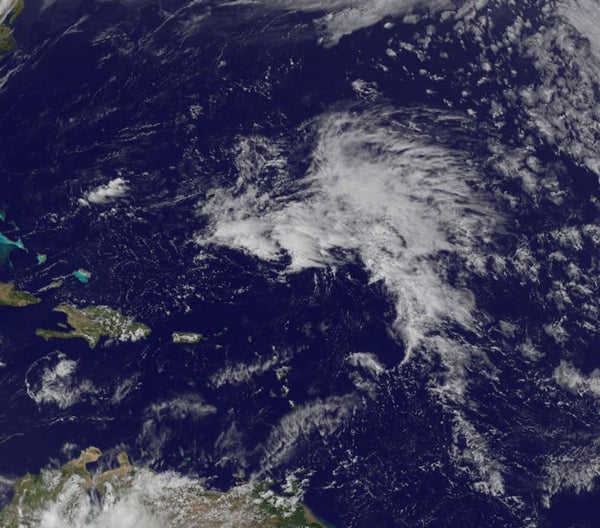
A low-pressure system swirling north-northwest of Puerto Rico is eager to get a jump start on hurricane season. The Atlantic hurricane season runs June through November, typically peaking in August and September.
Captured by the National Oceanic and Atmospheric Administration's GOES 13 satellite April 20, this early-bird system was seen creeping west-northwest at 16 kilometers per hour. The National Hurricane Center (NHC) issued a Special Tropical Weather Outlook reporting "some shower and thunderstorm activity" near the center of the low-pressure area—seen here in the western portion of the cloud mass. The NHC gave the system a 20 percent chance of developing into a cyclone within the next couple of days.
Many factors are required for low-pressure systems to morph into tropical cyclones, including warm ocean waters of at least 26.5 degrees Celsius; the system is currently over water at 25 degrees C. Tropical cyclones are further classified by their maximum sustained wind speed. The weakest cyclones are known as tropical depressions, which spin up to tropical storms when winds reach about 63 kph, or 34 knots, (at which point they are officially named) before finally attaining hurricane status at 119 kph, or 64 knots.
Since 1851 April has seen a total of one tropical storm, Ana of 2003, and no hurricanes, according to the Atlantic Oceanographic and Meteorological Laboratory. Odds are, this tropical upstart will remain nameless.
—Nina Bai