
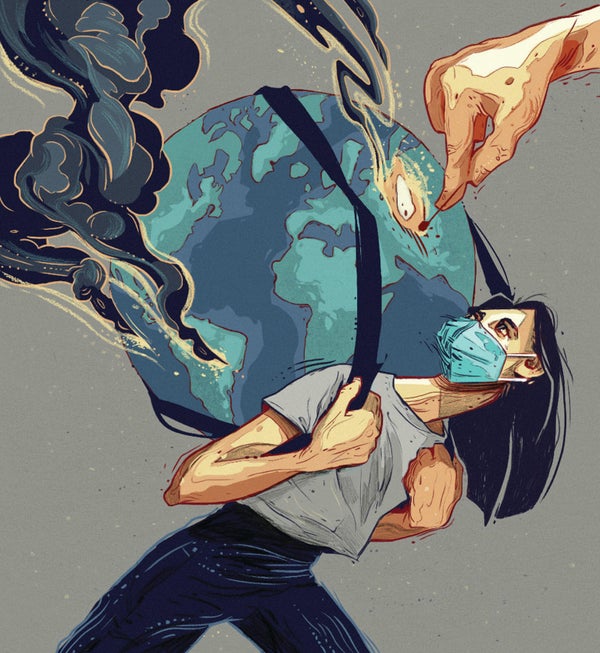
I've never known an Earth that wasn't on fire.
I'm 23 years old, and my entire generation has come of age in a world so defined by climate change and other forms of environmental degradation that it's sometimes been hard to fathom what an even more dismal future might look like. It has, that is, until the pandemic reared its ugly head. The fate of nature, like so much else, has temporarily become an agonizing side story to COVID—and now the environment is a real-time plot followed mostly, I think, by those of us young enough to one day see the worst of it.
At first, things seemed hopeful. Struggling to adjust to the new normal of life in quarantine in March and April, we were relieved to read that emissions levels had dipped, even if only temporarily, and that the skies over New Delhi and Los Angeles and Buenos Aires had cleared of smog. I smiled, as we all did, to notice that animals were roaming free through quiet, traffic-free cities. Nature seemed to be reclaiming spaces humans had abandoned. In the midst of so much present grief, these story lines gave us faith in the planet's resilience. Maybe, some optimists speculated, it would even inspire us to be better stewards of our world when this was over. This “anthropause” was a once-in-a-lifetime opportunity for humans to understand our impact on wildlife in a crowded world that seemed, for a moment, a little less crowded.
On supporting science journalism
If you're enjoying this article, consider supporting our award-winning journalism by subscribing. By purchasing a subscription you are helping to ensure the future of impactful stories about the discoveries and ideas shaping our world today.
But only for a moment. Pandemics like this happen and will keep happening because we humans have long encroached on wild spaces, increasing the chances of spillovers of disease from animals to people. In the temporary absence of international watchdogs and local enforcement, South America's Pantanal, the world's largest tropical wetland, has burned like never before. In May there was a major oil spill in the Russian Arctic, followed by others in places such as Mauritius and Venezuela—terrible ecological catastrophes that are buried underneath headlines of case numbers and mortality rates. Poaching is on the rise in Africa. The list goes on.
And in the U.S., we've somehow become less thoughtful in our daily choices—accepting that extra plastic bag at the supermarket, ordering takeout despite all the single-use containers and, if we're privileged enough, driving instead of taking public transportation—because, well, “it's a global pandemic.” Take a walk outside, and you'll find masks and latex gloves littering our streets and beaches and parks that will eventually fill rivers, lakes and seas.
It's as if the pandemic has suddenly given people everywhere even more of a license to dirty the world—if that's even possible—with carelessness, if not outright contempt. I fear that for every day it continues, today's young people will be paying the ecological price for the rest of our lives. I'm not just talking about those of us living in developed nations. I'm talking about children from impoverished families worldwide whose health and food security have plunged into even more uncertainty because of the devastating one-two punch of climate change and the coronavirus—both of which have laid bare systemic racism and socioeconomic inequities. I'm talking about young climate organizers across the globe who have been calling out people's ignorance of science for years and feel now more than ever that they're screaming into a void. And, perhaps most brutally, I'm talking about young Indigenous people in Latin America, whose entire cultures (many of them predicated on harmony with nature) are being erased as their elders die of infection and as ranchers and miners violently and illegally drive them from their ancestral lands.
In today's pandemic moment, nature's story line has reached a low point. It's unfathomable to me that some people can still so easily shrug it off—especially if they have kids or love anyone who is younger than they are—while for so many in my generation, it is such a constant, excruciating worry. Apathy, let alone denial, is no longer an acceptable option, because we know that if we stay on this course, the destruction will inevitably come for us, too.
But I like to think that the anthropause still gives some hope—that perhaps if we all live a little lighter, if we listen to those who are in harmony with the land and if we take solace in all that there is to love in the world, nature might meet us halfway. The planet and our fates hang in the balance.