

The nearest alien planet to Earth may not be an only child.
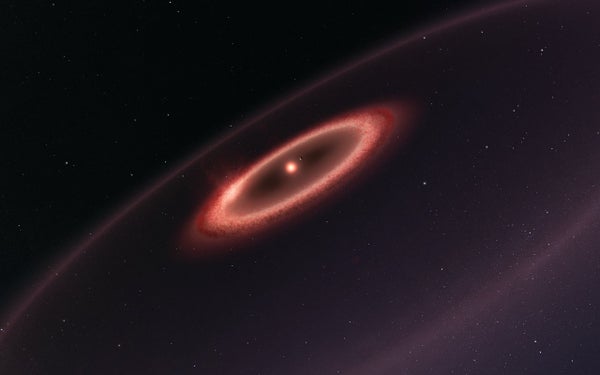
Astronomers have spotted a dusty ring around the nearby star Proxima Centauri, hinting at the existence of other planets in addition to the famous Proxima b, a new study reports.
"This result suggests that Proxima Centauri may have a multiple-planet system with a rich history of interactions that resulted in the formation of a dust belt," study lead author Guillem Anglada, an astronomer at the Instituto de Astrofisica de Andalucia in Spain, said in a statement. "Further study may also provide information that might point to the locations of as-yet unidentified additional planets." [Proxima b: Closest Earth-Like Planet Discovery in Pictures]
On supporting science journalism
If you're enjoying this article, consider supporting our award-winning journalism by subscribing. By purchasing a subscription you are helping to ensure the future of impactful stories about the discoveries and ideas shaping our world today.
Proxima Centauri is a red dwarf that lies about 4.2 light-years from Earth, in the southern constellation of Centaurus (The Centaur). In 2016, researchers spotted Proxima b, an apparently Earth-size world orbiting the star in what seems to be the habitable zone, the region where liquid water could exist on the surface. The star itself is about the same age as the sun. (Coincidentally, the team that discovered Proxima b was led by Guillem Anglada-Escudé of Queen Mary University of London, a part of Anglada's team but no relation to the author of the new research.)
Anglada and his colleagues studied Proxima Centauri using the Atacama Large millimeter/submillimeter Array (ALMA), a network of telescopes in Chile. The researchers discovered a belt of dusty material containing about 1 percent the mass of Earth. The belt — which lies a few hundred million kilometers from the star, far beyond Proxima b's orbit — has a temperature of about minus 328 degrees Fahrenheit (minus 230 degrees Celsius), roughly the same temperature of the solar system's Kuiper Belt, researchers said.
The dusty material might range in size from grains of only a few millimeters to asteroid-like bodies several kilometers across, study team members said. Dust belts like this are thought to be the remains of material that didn’t manage to clump together to form planets, they added.
ALMA also spotted signs of a possible second dust ring, about 10 times farther from the star than the other one, though this feature awaits confirmation. If the outer ring does indeed exist, its material would be very cold, lying so far from a star that is much smaller and dimmer than the sun.
The faint outer belt could prove useful to astronomers: Studying its shape could yield a better understanding of Proxima b's mass, which is not known very well at the moment, the researchers said.
And then there's the exploration angle. The $100 million Breakthrough Starshot project aims to send sail-equipped, laser-driven microprobes zooming past Proxima b in the not-too-distant-future, and mapping out the system's dust environment could be key to the success of such a mission, study team members said.
"These first results show that ALMA can detect dust structures orbiting around Proxima. Further observations will give us a more detailed description of Proxima's planetary system," study co-author Pedro Amado, also from the Instituto de Astrofiscia de Andaluicia, said in the same statement. "What we are seeing now is just the appetizer compared to what is coming!"
The new study has been accepted for publication in Astrophysical Journal Letters.
EDITOR'S RECOMMENDATIONS
Copyright 2017 SPACE.com, a Purch company. All rights reserved. This material may not be published, broadcast, rewritten or redistributed.