
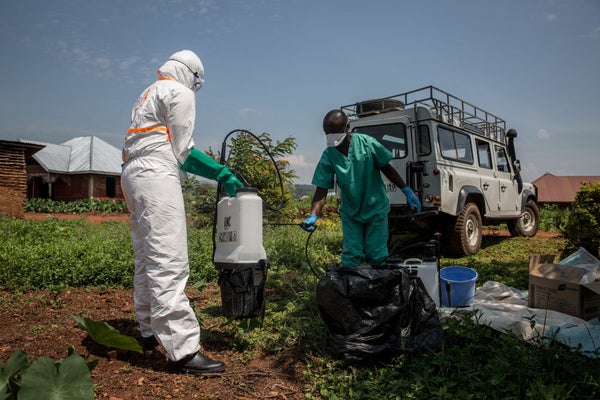
The World Health Organization (WHO) has declared the worsening Ebola outbreak in the Democratic Republic of the Congo (DRC) a public-health emergency of international concern (PHEIC). The move came amid renewed fears that the virus could spread beyond the DRC’s borders.
The declaration is the WHO’s highest level of alarm. This is the fifth time that the agency, an arm of the United Nations, has declared a global emergency—a step it reserves for events that pose a risk to multiple countries and that require a coordinated international response.
More than 2,500 people have become ill and nearly 1,700 have died during the DRC outbreak, making it the second-worst on record. The WHO’s investigations have suggested that the virus began spreading in the eastern DRC a few months before the outbreak was declared in August 2018.
On supporting science journalism
If you're enjoying this article, consider supporting our award-winning journalism by subscribing. By purchasing a subscription you are helping to ensure the future of impactful stories about the discoveries and ideas shaping our world today.
“Now is the time for the international community to stand in solidarity with the people of Congo,” said WHO director-general Tedros Adhanom Ghebreyesus at a press briefing on 17 July.
Growing concern
Ghebreyesus urged countries and companies around the world to keep their borders open to travel and trade with the DRC, despite the declaration of a public-health emergency. Doing otherwise would harm the DRC’s economy, and also prevent people in the conflict-ridden North Kivu and Ituri provinces, where Ebola is spreading, from fleeing violence.
Restricting travel might also prompt people in the eastern DRC to enter neighbouring countries outside official checkpoints, where health workers record the names of travellers and check their temperatures.
The DRC health ministry reiterated those concerns in a statement issued after the WHO made its emergency declaration, emphasizing the risks to “communities that rely heavily on cross-border trade for their survival”.
The WHO had three times previously considered and rejected declaring an emergency in the DRC. Its latest action came after recent reports of people with the virus travelling into areas beyond the outbreak zone.
On 14 July, doctors in Goma confirmed that a pastor who travelled to the city by bus from the city of Butembo, a hotspot of the outbreak, had contracted Ebola. He died two days later. And on 17 July, the DRC health ministry and the WHO reported that a woman who was diagnosed with Ebola in the DRC had travelled to Uganda through an illegal border crossing last week to sell fish. While there, she vomited four times—a symptom of Ebola. She died on 15 July.
Continued attacks on health workers, including the killing of two Congolese Ebola responders in Beni last week, also influenced the WHO’s decision.
“The fight is ongoing for a full year now, and the assassination of two Ebola workers demonstrates the continued risk due to the security situation,” said Robert Steffen, an epidemiologist at the University of Zurich in Switzerland and chair of the WHO advisory committee that recommended the emergency declaration.
Help needed
Steffen said that the panel was also concerned that the WHO lacked sufficient money and staff to curtail the outbreak.
Many public-health specialists have speculated that declaring a global emergency would prompt wealthy countries to contribute more resources to the Ebola fight. “I applaud Dr Tedros for declaring an emergency,” says Lawrence Gostin, a health-law and policy specialist at Georgetown University in Washington DC. “Unless there is a real surge in the response, I fear [the outbreak] will go on.”
But Ghebreyesus stressed that the emergency declaration is not a fundraising tool. “The WHO is not aware of any donor who has withheld funding because a PHEIC is not declared,” he said.
This article is reproduced with permission and was first published on July 17, 2019.