
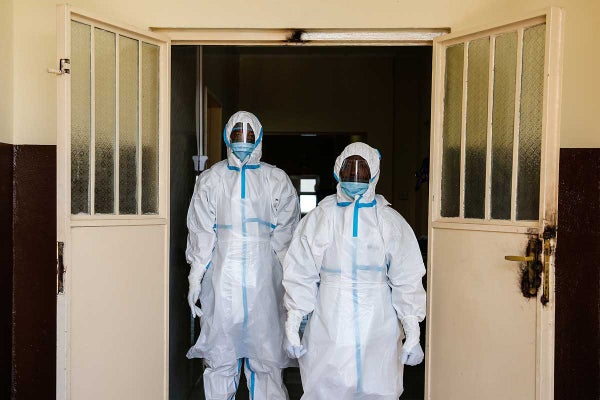
When the World Health Organization declared on January 14 that the spread of Ebola had been halted in West Africa, it cautioned that cases of the virus might yet re-emerge. That is exactly what has happened in Sierra Leone, where a new death from Ebola was announced hours after the WHO's statement.
Health officials told reporters that a 22-year-old woman had died in Magburaka after falling ill in Baomoi Luma, near the border with Guinea. A positive test for Ebola was confirmed only after her death, which occurred earlier in the week, raising concerns that she may have been in contact with others while contagious.
The case is Sierra Leone's first since it was declared free of Ebola on 7 November, although the country was still in a 90-day period of enhanced surveillance. The WHO and local partners said they were investigating its origin and identifying the woman’s contacts.
On supporting science journalism
If you're enjoying this article, consider supporting our award-winning journalism by subscribing. By purchasing a subscription you are helping to ensure the future of impactful stories about the discoveries and ideas shaping our world today.
Flare-ups expected
Although Ebola’s epidemic phase appears over, isolated cases are widely expected. The WHO considers that human transmission of the virus has been halted when a country has had no new cases for 42 days (twice the virus’s incubation period)—but the virus can persist in survivors for months in semen, and also in tissues such as the eye, the central nervous system, the prostate gland, and the placenta. It also remains hidden in animal reservoirs.
Liberia, for example, was pronounced Ebola-free in May 2015, but the virus flared up twice before the WHO could declare the country Ebola-free again on 14 January. “We are now at a critical period in the Ebola epidemic as we move from managing cases and patients to managing the residual risk of new infections,” Bruce Aylward, who leads the WHO’s Ebola response, said.
There is a particular focus on the potential of sexual transmission of Ebola to cause occasional cases. After a first-known case of sexual transmission of Ebola, in Liberia, was confirmed last October, Armand Sprecher, a public health specialist with Médecins sans Frontières (Doctors without Borders) in Brussels, wrote in an editorial: "The challenge with sexual transmission is not that it would be a source of many new Ebola virus disease cases, but that it may be a source of late cases.”
This article is reproduced with permission and was first published on January 15, 2016.