
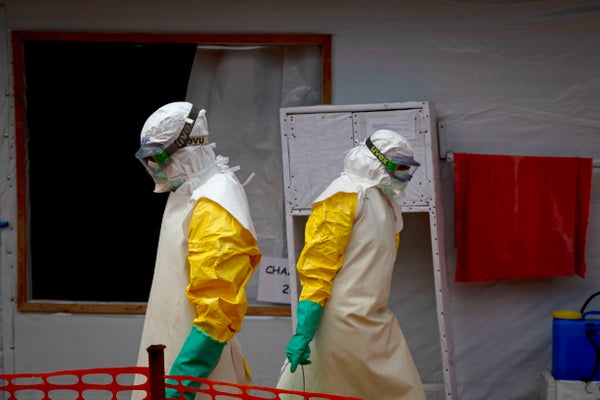
Four people working for the Ebola containment effort in the Democratic Republic of the Congo were killed overnight Thursday in attacks on two locations where response teams were operating. Another six people were injured in the violence, forcing the World Health Organization and partner agencies to withdraw staff from a strategically critical location, a senior WHO official said.
The attack was the deadliest yet during a 17-month outbreak in which response workers have been frequently targeted for violence, said Dr. Mike Ryan, executive director of the WHO’s emergencies program, speaking with reporters from Geneva.
WHO Director-General Tedros Adhanom Ghebreyesus condemned the attacks.
On supporting science journalism
If you're enjoying this article, consider supporting our award-winning journalism by subscribing. By purchasing a subscription you are helping to ensure the future of impactful stories about the discoveries and ideas shaping our world today.
“These constant attacks must stop,” Tedros, as he is known, said in a video the WHO distributed on social media. “We call on everyone who has a role to play to end this cycle of violence.”
Three of the deaths occurred in an ambush of an accommodations camp housing 189 response workers at a place called Biakato Mines. In a separate attack at a coordination office in Mangina, a policeman guarding response workers was killed.
“We are heartbroken that they died as they worked to save others,” Ryan said.
To date, he said, there have been 386 attacks on response workers, with at least seven deaths and 77 injuries. Many other times, response teams have been caught in the crossfire between the multiple rebel groups that operate in the Ebola-affected area and the government and United Nations. peacekeeping troops in the region.
The latest violence dashes hopes that the outbreak might be in its final throes.
Months of intense effort to try to stop transmission of Ebola in the provinces of North Kivu and Ituri were paying off. There have been fewer cases to date in November than any month since the outbreak began. For perhaps the first time, the response teams had a good handle on where the virus was spreading, with 98% of cases occurring in two chains of transmission. Containment efforts were working.
“We were in a position where we were really starting to get on top of this virus,” Ryan said. “Ebola was retreating. And now it is likely to resurge. … When responders aren’t in the community, the virus spreads undetected and uninterrupted.”
This is the second largest Ebola outbreak ever, with more than 3,300 cases and 2,200 deaths. Though this one is almost 10 times smaller than the West African outbreak of 2014-2016, Ryan and others have called the North Kivu-Ituri outbreak the most difficult ever, occurring as it is in a region that is home to upwards of 8 million people and that has been mired in conflict for more than two decades.
Despite use of a highly effective vaccine and drugs that have been proven in this outbreak to reduce deaths, the response workers have struggled to gain the acceptance and assistance of people in affected communities.
Community resistance remains a problem at Lwemba, a health zone near Biakato Mines that is currently the place where most transmission is occurring. Even before the violence, response teams had encountered difficulties in Lwemba. The camp at Biakato Mines housed people who had been working in Lwemba. “Now without our teams on the ground, we have even less access,” Ryan said.
Violence earlier in the outbreak fueled spread of the Ebola virus, with a massive surge of cases in March, April, and May after multiple late February attacks on response operations, including two treatment centers that were razed.
Ryan was clearly bracing for the prospect that this pattern is about to be repeated. “We’ve seen the impact previously of long-term interruptions of operations,” he said, adding that it’s impossible to predict at this point how soon full response operations will be able to resume.
Republished with permission from STAT. This article originally appeared on November 28 2019