
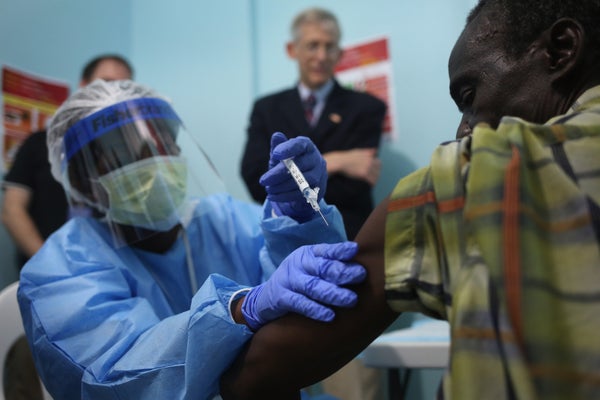
An international consortium of researchers has reported that an Ebola vaccine appears to provide volunteers protection against the virus two years after they were injected—encouraging findings both for the public health community and the vaccine’s manufacturer.
An earlier study, conducted in Guinea near the end of the devastating West African Ebola outbreak, showed the vaccine from Merck, which is given in a single shot, rapidly generated protection against the virus. But how long that protection lasts remained an open question.
A fast-acting, long-lasting vaccine given in a single dose would be an effective tool for controlling dangerous Ebola outbreaks. Vaccinating health care workers, for instance, could prevent the type of spread within hospitals that, in the early days of an outbreak, can turn a smoldering outbreak into a conflagration.
On supporting science journalism
If you're enjoying this article, consider supporting our award-winning journalism by subscribing. By purchasing a subscription you are helping to ensure the future of impactful stories about the discoveries and ideas shaping our world today.
“The ideal vaccine in these regions would have long-term durability,” said Dr. Angela Huttner, an infectious diseases specialist at Switzerland’s University Hospitals of Geneva and the lead author of the paper. “This is really good news because this vaccine is destined for places where logistics are very difficult. Having to do booster shots would be very impractical in these regions.”
The
new study, published in Lancet Infectious Diseases, shows that two years after getting the vaccine, volunteers had high and stable levels of antibodies to the Ebola Zaire virus. (This vaccine only targets that one strain of Ebola.) Volunteers who received a high dose of the vaccine had, on average, higher antibody levels than people who received a lower dose. But there were solid levels of antibodies even among people who got the lower dose.
“It’s very encouraging,” Michael Osterholm, director of the University of Minnesota’s Center for Infectious Diseases Research and Policy, said of the new findings. Osterholm was not involved in the study.
Merck, which has said it is working toward a 2018 licensure filing with the Food and Drug Administration, also welcomed the results.
“This publication is the first demonstration of the durability of the antibody responses induced by V920 out to 2 years,” the company said in a statement, using its developmental name for the vaccine. (In scientific trials, the vaccine is identified as rVSV-ZEBOV.)
“We are encouraged by these important results and testing of long-term follow-up samples from additional trials is planned or ongoing to corroborate these findings,” Merck said.
Huttner and colleagues conducted a Phase 1 trial of the vaccine in 2014-2015 in Switzerland. This new paper stems from a follow-up.
For this study, the Swiss researchers pooled data with two other groups that conducted Phase 1 trials of the vaccine in Africa—in Lambaréné, Gabon, and Kilifi, Kenya. In total, they had data from 197 people who received the vaccine. Both the Geneva and the Gabon volunteers will be followed for five years to see what happens to antibody levels over time. The Kenyan trial is finished.
Huttner said her team recently completed blood draws from the Geneva volunteers to look at the antibody levels after three years, but they have not yet had time to analyze the samples.
The study charts two years of antibody levels for the people vaccinated in Geneva and one year each in Gabon and Kenya. It found that antibodies that specifically target the main protein on the exterior of the Ebola virus remained high. But levels of another type of antibody, called neutralizing antibodies, dropped off quite quickly. Huttner noted, however, that may be a testing problem; there isn’t a good test to measure neutralizing antibodies to Ebola.
With Ebola, it is not clear exactly what is needed to protect against infection. But Huttner said the thinking is that the Ebola-specific antibodies are more important.
She is hopeful the data at two years will prove to be predictive of long-term protection. “Our hypothesis is that the values we’re seeing at two years shouldn’t change too much at three, four, and five years.”
If true, the vaccine could potentially be useful in both an emergency response setting and as a longer-term tool to protect scientists who work with Ebola virus, Doctors Without Borders teams that typically lead Ebola responses, and health care workers in places where Ebola outbreaks could crop up.
It has been thought that long-term protection might require a two-dose vaccine, like the type being developed by Janssen Vaccines and Prevention BV, a subsidiary of Johnson & Johnson.
Osterholm warned it is too early to say if the Merck’s vaccine’s protection will be that durable. “We don’t know that yet,” he said.
Republished with permission from STAT. This article originally appeared on April 16, 2018