
Bats have to leave the safety of their roosts every night to find food. That takes energy: their insect prey must provide them with enough fuel to offset the cost of hunting in the first place.
Because bats use the same chest and abdominal muscles for both flying and producing echolocation calls, many researchers thought vocalizing while airborne would not consume significantly more energy than flying alone. But a new study has thrown that idea into serious doubt. The results were published in Nature Ecology & Evolution.
“When they are calling quietly ... those original assumptions hold,” says Shannon Currie of the Leibniz Institute for Zoo and Wildlife Research in Germany. But “getting loud becomes extremely expensive.”
On supporting science journalism
If you're enjoying this article, consider supporting our award-winning journalism by subscribing. By purchasing a subscription you are helping to ensure the future of impactful stories about the discoveries and ideas shaping our world today.
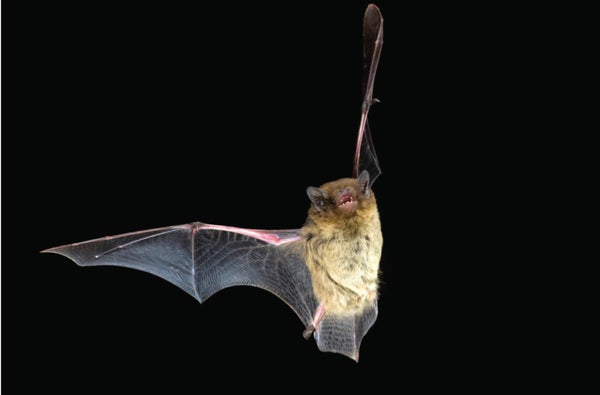
Currie and her team measured metabolism and echolocation intensity for nine Nathusius's pipistrelle bats, captured from urban areas in Berlin and released after laboratory tests. When subjected to just the normal ambient sounds while flying in a wind tunnel, the bats called at 113 decibels. But when the researchers played extra ultrasonic noise, the bats “shouted” at 128 decibels—requiring about 30 times as much energy, Currie says. Although their calls are inaudible to humans, this jump in volume is proportionally equivalent to the difference between a nearby chainsaw and a jet engine, says University of Winnipeg biologist Craig Willis, who specializes in bats and was not involved in the new study.
To compensate for the additional calories they burn by turning up their volume so dramatically, the bats would have to gobble up an extra half a gram of insects (around 7 percent of their body mass) each night. “That's a turkey dinner for us; that's a big deal,” Willis says.
Getting enough nourishment to afford calling over the sounds of human-generated ultrasonic noise, from traffic or heavy machinery, for example, may be difficult for bats in habitats with dwindling insect populations. “In many ways, insect conservation is bat conservation,” Willis says, “and we're in the midst of this insect apocalypse where we're losing insects at alarming rates.” What that means, Currie says, is that bats in many areas now have to work harder to find the fewer insects available. If they burn more calories hunting than they acquire from their prey, it could spell trouble for the flying mammals. Human-made noise adds yet one more hurdle to their survival.