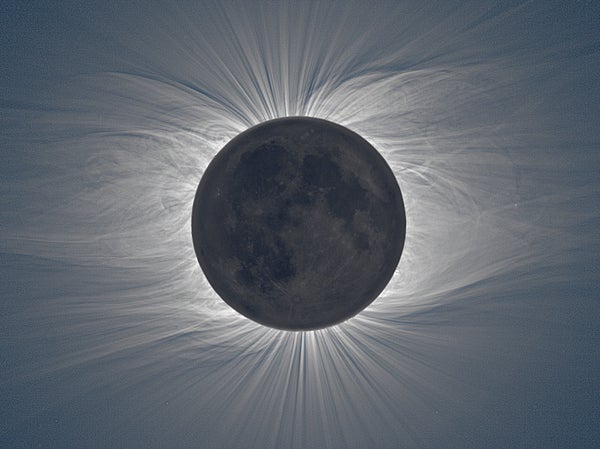
Eclipse Photograph Exposes Details of Both Sun and Moon

July 22, 2009, brought the longest total solar eclipse that Earth will witness in the 21st century.

© 2009 Miloslav Druckmüller, Peter Aniol, Vojtech Rušin, Ĺubomír Klocok, Karel Martišek, Martin Dietzel

Join Our Community of Science Lovers!


On supporting science journalism

If you're enjoying this article, consider supporting our award-winning journalism by subscribing. By purchasing a subscription you are helping to ensure the future of impactful stories about the discoveries and ideas shaping our world today.


July 22, 2009, brought the longest total solar eclipse that Earth will witness in the 21st century. Visible within a narrow band snaking across Asia and the Pacific Ocean, the totality of the eclipse lasted up to six minutes and 39 seconds, a duration that will not be surpassed until 2132. At Enewetak Atoll in the Marshall Islands, where the first hydrogen bomb was tested by the U.S. in 1952, the totality lasted more than five and a half minutes.

Miloslav Druckmüller, a mathematician at the Brno University of Technology in the Czech Republic, and his colleagues were on Enewetak as the eclipse's shadow raced toward them from the northwest at more than twice the speed of sound. This composite of 31 images from the eclipse shows the solar corona, the wispy "atmosphere" of the sun peeking out from behind the moon as well as the cratered, rayed surface of the moon itself.

Druckmüller, who specializes in eclipse photography, wrote a 2006 article for Scientific American explaining some strategies for capturing such phenomena. But aspiring eclipse shutterbugs will have to wait—the path of the next total solar eclipse, in July, will barely touch land, and the occultation of November 2012 will just graze northern Australia. The next total solar eclipse with significant land coverage will cross Indonesia in 2016.

It’s Time to Stand Up for Science

If you enjoyed this article, I’d like to ask for your support. Scientific American has served as an advocate for science and industry for 180 years, and right now may be the most critical moment in that two-century history.

I’ve been a Scientific American subscriber since I was 12 years old, and it helped shape the way I look at the world. SciAm always educates and delights me, and inspires a sense of awe for our vast, beautiful universe. I hope it does that for you, too.

If you subscribe to Scientific American, you help ensure that our coverage is centered on meaningful research and discovery; that we have the resources to report on the decisions that threaten labs across the U.S.; and that we support both budding and working scientists at a time when the value of science itself too often goes unrecognized.

In return, you get essential news, captivating podcasts, brilliant infographics, can't-miss newsletters, must-watch videos, challenging games, and the science world's best writing and reporting. You can even gift someone a subscription.

There has never been a more important time for us to stand up and show why science matters. I hope you’ll support us in that mission.

Thank you,

David M. Ewalt, Editor in Chief, Scientific American

Subscribe