
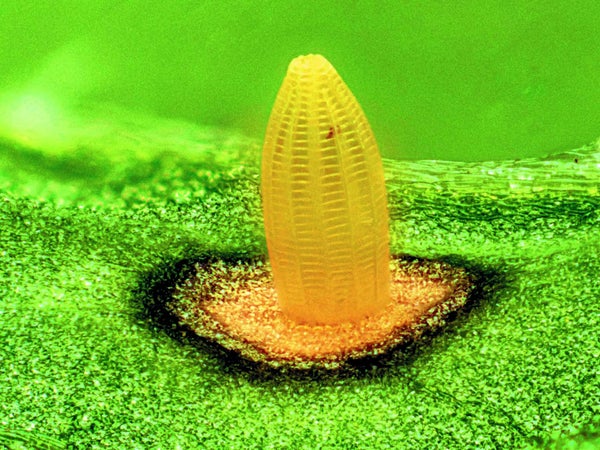
A few plants in the cabbage and mustard family pay a dramatic price to fend off hungry caterpillars: they kill off patches of their own leaves where butterflies have laid eggs. Deprived of a living anchor, the eggs shrivel and die. These plants' egg-slaying abilities have been documented since at least the 1980s, but a new study shows they appear in just a few closely related plants in this family—and they are triggered only by certain butterfly species.
Nina Fatouros of Wageningen University in the Netherlands and her colleagues investigated 31 plant species in the target family. First, they dabbed the plants' leaves with liquid that had been exposed to egg material from a butterfly species known to lay eggs on them. Four closely related plant species reliably killed off the treated leaf patches. Further tests confirmed that the species with the most pronounced response only reacted strongly when the egg material came from one group of butterflies, Pieris, which lays eggs on these plants in the wild. This is “clear evidence” that specific butterfly species could have stimulated the evolution of the necrosis defense, Fatouros says. The researchers also tracked eggs laid by wild butterflies to confirm that the defense mechanism desiccates or detaches them. The work was detailed in New Phytologist.
“It's very unlikely that you find this by coincidence,” says University of Sheffield molecular plant biologist Jurriaan Ton, who was not involved in the study. He adds that the plants' relatedness, coupled with their exaggerated reaction to these butterflies, suggests a heated evolutionary “arms race” took place between the plants and insects.
On supporting science journalism
If you're enjoying this article, consider supporting our award-winning journalism by subscribing. By purchasing a subscription you are helping to ensure the future of impactful stories about the discoveries and ideas shaping our world today.
“This is the first study to my knowledge where they really looked at the appearance of this trait within a particular plant family,” says ecologist Julia Koricheva of Royal Holloway, University of London, who was also not involved in the work.
Future research could explore how recently the trait evolved, Fatouros says. She notes that arms races rarely end—and evidence suggests the butterflies may be fighting back. Some prefer to lay their eggs in tightly grouped clusters, making them less susceptible to the plants' strategy.