
Scientists have demonstrated that Einstein's theory of general relativity is correct to a remarkable degree of accuracy, despite having been around for more than a century.
The team behind the research wanted to test a component of
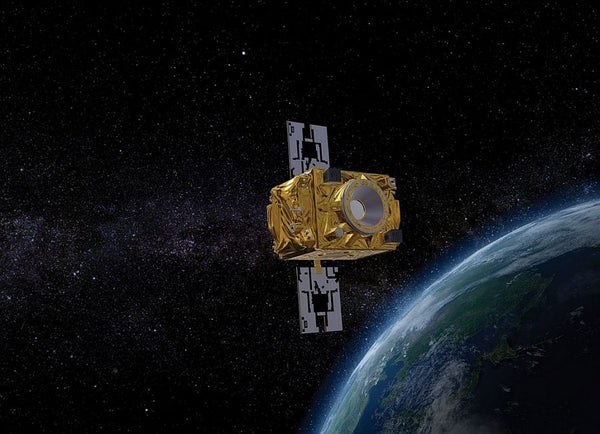
Einstein's theory of general relativity called the weak equivalence principle, which states that all objects, regardless of their mass or composition, should free-fall the same way in a particular gravitational field when interference from factors like air pressure is eliminated. To do so, the scientists measured the acceleration of free-falling objects in a French satellite called MICROSCOPE, which launched in 2016.
On supporting science journalism
If you're enjoying this article, consider supporting our award-winning journalism by subscribing. By purchasing a subscription you are helping to ensure the future of impactful stories about the discoveries and ideas shaping our world today.
One of the most famous tests of the weak equivalence principe occurred during an
Apollo 15 moonwalk, when astronaut David Scott dropped a feather and a geological hammer at the same time; without air resistance, both objects accelerated toward the moon's surface at the same rate. In similar style, MICROSCOPE carries free-falling test masses made of platinum and titanium alloys. Electrostatic forces keep the test masses in the same relative positions to each other, so any difference generated in this applied electrostatic force would have to be the result of deviations in the objects' accelerations.
The team's results, which are the culmination of 20 years of research, revealed that acceleration in pairs of objects in free fall differed by no more than 1 part in 10^15, or 0.000000000000001, meaning they found no violations in the weak equivalence principle larger than that.
As well as placing constraints on deviations in the weak equivalence principle, the findings also disfavor any deviations in Einstein's 1915 theory of
gravity, general relativity, as a whole. Scientists continue to look for such deviations because general relativity, the best description we have of gravity, doesn't jive with quantum physics, the best model we have of reality at incomprehensibly small scales.
No sign of deviation, then, means still no hint of extensions to general relativity waiting to be found that could bridge the gap to quantum physics.
"We have new and much better constraints for any future theory because these theories must not violate the equivalence principle at this level," Gilles Métris, a MICROSCOPE team member and a scientist at the Côte d'Azur Observatory in France, said in a
statement from the American Physical Society, which published the research.
MICROSCOPE launched in April 2016 and mission personnel released its preliminary results 2017. Data analysis has continued ever sense, even after the experiment ended in 2018.
The fact the new research found no violation of the weak equivalence principle puts the highest constraints yet on this element of general relativity, and the results also lay the groundwork for even more sensitive tests in the future.
That's because the scientists included suggestions for how the experimental setup they used could be improved. Potential upgrades include reducing imperfections in the coating of satellites that can impact acceleration measurements as well as replacing wired systems with ones that use wireless connections, they wrote.
A satellite implementing these improvements could potentially pick up violations of the weak equivalence principle as tiny as 1 part in 10^17, 100 times more sensitive than MICROSCOPE. But the team predicts these improvements won't be feasible for some time yet, meaning that for now, the MICROSCOPE experiment will remain the best test of the weak equivalence principle.
"For at least one decade or maybe two, we won't see any improvement with a space satellite experiment," Manuel Rodrigues, a MICROSCOPE team member and a scientist at ONERA, a French research institute specializing in aerospace, said in the same statement.
The team's research was published Wednesday (Sept. 14) in the journal Physical Review Letters and a special issue of Classical and Quantum Gravity.
Copyright 2022 Space.com, a Future company. All rights reserved. This material may not be published, broadcast, rewritten or redistributed.