
By Lisa Rapaport
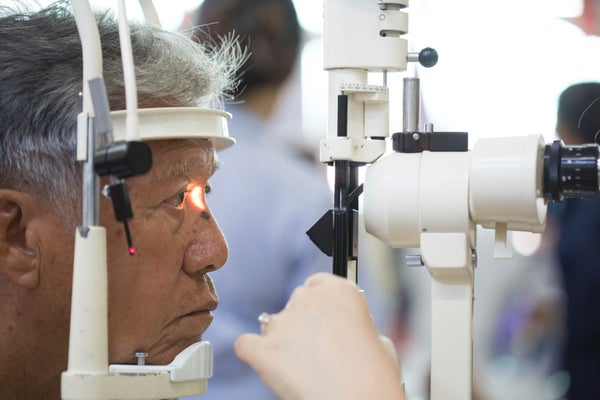
(Reuters Health) - There isn't enough evidence yet to say for sure whether primary care doctors should offer routine vision screening to elderly people who don't report any problems with their eyes, new U.S. guidelines conclude.
When primary care physicians routinely screen adults over 65, it doesn't appear to result in better outcomes than only testing patients with symptoms such as blurred or distorted vision, sensitivity to bright light or difficulty seeing in low light, the U.S. Preventive Services Task Force (USPSTF) concluded.
On supporting science journalism
If you're enjoying this article, consider supporting our award-winning journalism by subscribing. By purchasing a subscription you are helping to ensure the future of impactful stories about the discoveries and ideas shaping our world today.
Even though early detection of vision difficulties may lead to better quality of life, greater independence and a lower risk of falls in older adults, routine screening doesn't appear more effective than only testing patients with symptoms, the USPSTF reports in JAMA March 1.
"Older age is an important risk factor for most types of vision problems," Dr. Albert Siu, USPSTF chair, said by email.
However, research to date on routine screening suggests that "the net benefit to offering this service is small and should be done on an individual basis," added Siu, who is also affiliated with the Icahn School of Medicine at Mount Sinai in New York City.
While vision screening probably isn't harmful, some age-related eye conditions like macular degeneration and cataracts may be difficult to detect before patients have pronounced symptoms because people in the early stages of these diseases may still be able to read eye charts used to test vision.
Macular degeneration, for example, might initially surface as a distortion of straight lines or a dark, blurry or white out spots in the center of vision. Cataracts, may first be noticed when vision is cloudy, blurred or dimmed.
Screening in primary care may not always be effective in part because some patients fail to get needed follow-up evaluations with eye specialists, said Dr. Roger Chou, a researcher at Oregon Health and Science University in Portland and lead author of a research review on vision screening published with the USPSTF recommendations.
"It would be helpful to have research looking to see whether screening interventions coupled with strategies to increase uptake of recommended evaluations and treatments may be more effective in improving outcomes," Chou said by email.
There are two potential pitfalls with routine vision screening that uses standard eye charts, typically rows of letters people read from a distance, said Dr. Paul Lee, director of the W.K. Kellogg Eye Center at the University of Michigan in Ann Arbor and author of an accompanying editorial in JAMA.
"One: those who 'pass' may think that they are without evidence of eye disease though they may be 'false negative' and might delay in seeking care with the development of symptoms, thinking that they had already had an eye exam, and, two, those under the care of an eye doctor may perceive a different situation than their doctor has described," Lee said by email.
The recommendations may also fail to find sufficient proof that routine screenings work because they're only looking at research done in primary care, not studies of outcomes from evaluations done by vision specialists, noted Dr. David Parke II, chief executive of the American Academy of Ophthalmology in San Francisco and author of an editorial in JAMA Ophthalmology March 1.
"A significant amount of that information already exists," Parke said by email.
One large study found seniors with eye exams were less likely to develop challenges with daily living, while other research has found undetected eye disease and vision loss associated with decreased quality of life, Parke added.
The main potential harm from screening in primary care might be some unnecessary specialist referrals, Parke said. Patients would still get appropriate treatment because ophthalmologists can determine the cause of vision problems and assess what interventions might be needed.
Solid proof that vision screening in primary care is safe and effective may never materialize because scientists won't do large, costly studies to test such a common-sense idea, said Dr. Alfred Sommer, a researcher at the Wilmer Eye Institute at Johns Hopkins University in Baltimore, Maryland.
"To most people, especially ophthalmologists, common sense would suggest that there is little harm in simply measuring the vision at a distance during a patient's routine visit to their primary care physician," Sommer, who wrote an editorial in JAMA Internal Medicine, said by email. "Nor can one conceive how that might prove harmful."