Election Day 2018 Takes Absentee Ballots to the Extreme in Space

Even on the International Space Station, American astronauts manage to vote

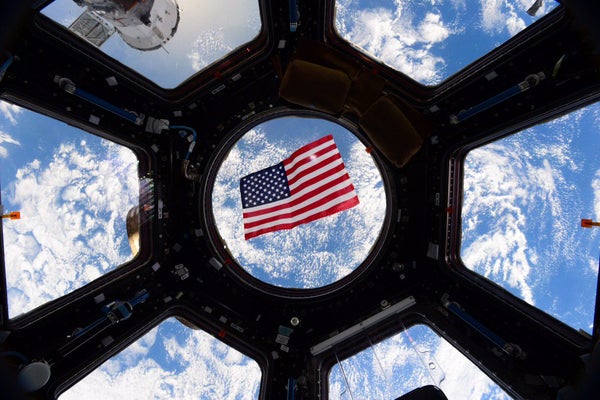
An American flag floats in weightlessness, with the Earth as a magnificent backdrop, in this photo from the Cupola observation room on the International Space Station.

Join Our Community of Science Lovers!

Even the International Space Station has a local polling site, thanks to a Texas law that arranges special absentee ballots for U.S. astronauts who are in orbit on Election Day.

In order to vote from space, astronauts request a special absentee ballot about six months in advance, according to NASA. On the big day, they file their ballot electronically through a protected system. The process has been in use since 1997, when a U.S. astronaut voted from aboard the Russian Space Station Mir, which preceded the International Space Station.

This Election Day, just one U.S. astronaut is aboard the space station, Serena Auñón-Chancellor. She did not respond to a request for comment through NASA's press office about whether she would be voting from space.


On supporting science journalism

If you're enjoying this article, consider supporting our award-winning journalism by subscribing. By purchasing a subscription you are helping to ensure the future of impactful stories about the discoveries and ideas shaping our world today.


A second NASA astronaut expected to be voting from space this year but now isn't. Nick Hague, who was scheduled to fly to the station in October for a six-month stay, told Space.com through a NASA spokesperson that he had requested an absentee ballot in preparation for being off Earth on Election Day.

However, the Soyuz rocket that he boarded for the trip experienced a failure during launch on Oct. 11, sending him and his Russian colleague plummeting abruptly to Earth. After a safe landing, he was able to cancel the arrangement, he said, and he and his family participated in early voting on Oct. 27, he told NASA. (Texas allowed early voting between Oct. 22 and Nov. 2 this year.)

Copyright 2018 Space.com, a Future company. All rights reserved. This material may not be published, broadcast, rewritten or redistributed.

Meghan Bartels is a science journalist based in New York City. She joined Scientific American in 2023 and is now a senior reporter there. Previously, she spent more than four years as a writer and editor at Space.com, as well as nearly a year as a science reporter at Newsweek, where she focused on space and Earth science. Her writing has also appeared in Audubon, Nautilus, Astronomy and Smithsonian, among other publications. She attended Georgetown University and earned a master’s degree in journalism at New York University’s Science, Health and Environmental Reporting Program.

More by Meghan Bartels

SPACE.com is the premier source of space exploration, innovation and astronomy news, chronicling (and celebrating) humanity's ongoing expansion across the final frontier.

More by SPACE.com

It’s Time to Stand Up for Science

If you enjoyed this article, I’d like to ask for your support. Scientific American has served as an advocate for science and industry for 180 years, and right now may be the most critical moment in that two-century history.

I’ve been a Scientific American subscriber since I was 12 years old, and it helped shape the way I look at the world. SciAm always educates and delights me, and inspires a sense of awe for our vast, beautiful universe. I hope it does that for you, too.

If you subscribe to Scientific American, you help ensure that our coverage is centered on meaningful research and discovery; that we have the resources to report on the decisions that threaten labs across the U.S.; and that we support both budding and working scientists at a time when the value of science itself too often goes unrecognized.

In return, you get essential news, captivating podcasts, brilliant infographics, can't-miss newsletters, must-watch videos, challenging games, and the science world's best writing and reporting. You can even gift someone a subscription.

There has never been a more important time for us to stand up and show why science matters. I hope you’ll support us in that mission.

Thank you,

David M. Ewalt, Editor in Chief, Scientific American

Subscribe