
PALO ALTO, Calif. -- Jane Koca grinned as she stepped out of a Tesla Model S at a neighbor's ride-and-drive event, where half a dozen models were on display. Her next car, she said, will be a plug-in.
"I've been waiting," she said. "Each year, they get better and better."
The rollout of new and second-generation plug-in models that can go longer on a single charge by major automakers has ushered in what some analysts call a second era in electric vehicles. As a response, sales of plug-in cars in recent months have been ticking upward, despite low gas prices. Older models have made their way onto an increasingly flourishing used car market.
On supporting science journalism
If you're enjoying this article, consider supporting our award-winning journalism by subscribing. By purchasing a subscription you are helping to ensure the future of impactful stories about the discoveries and ideas shaping our world today.
It remains niche enough, however, that incentives can play an outsized role.
For example, the used Toyota Prius plug-in hybrid is selling around twice as fast this year as last year on used car website iSeeCars.com, and twice as fast as the average car. More than half of them are sold in California -- and the state's infamous traffic is part of the reason.
"California has stopped giving out stickers for high-occupancy vehicle lane access for single occupants of plug-in vehicles," said Phong Ly, CEO of iSeeCars.com. "Really, the only way to get one is by buying a used plug-in. It could be a factor at play."
The three fastest-selling models across the website from January to May were the Toyota Prius plug-in hybrid, the Nissan Leaf and the Tesla Model S. EVs as a group are getting snatched up 10 days faster than gasoline-powered cars on the website.
Alternative fuel cars are also selling in larger numbers and at a lower prices on the website than last year, according to an analysis by the firm.
Most American families can't afford a new car, according to a Bankrate Inc. study released last week. The average new car sells for $33,865, according to Kelley Blue Book, and a new plug-in car costs more. But used cars are getting cheaper.
So far this year, prices for used EVs dropped 15 percent from the same period last year, and the price of used plug-in hybrids dropped 5 percent, according to iSeeCars.com. By comparison, the price of used gasoline-powered cars dropped 1 percent.
"You have a lot of 1-to-3-year-old models coming off lease," Ly said. "The lower prices have hit a sweet spot, and maybe that's why people who are generally reluctant may take a chance in buying."
A used Nissan Leaf, first introduced in 2010, is now selling at an average of $12,533, a drop in more than $2,000 from last year. That's in part because cars coming off leases in Georgia are flooding the market. The state was a top market for EVs because of a $5,000 tax credit until the incentives were ended last summer. Now, the share of used EVs sold in the state has doubled. People as far as Missouri have been snatching up the cheap Georgian Leafs.
1% of new car sales
Sales of new electric cars reached 1 percent of total U.S. new car sales for the first time in June, which environmentalists applauded as a milestone.
So far this year, sales of new plug-ins have been near or at record levels every month. High-end models, like the Tesla Model S and X or the BMW i3, have dominated, overtaking the previously popular Leaf and Volt.
The total volume of sales remains below expectations. California and nine other states have mandated that zero-emissions vehicles make up 15 percent of sales by 2025.
Sales of the plug-in vehicles dipped last year, but Scott Shepard, senior research analyst at Navigant Research, resisted tying that trend entirely to low gas prices.
"The people who are going after that technology are going after it because it has a plug, not because it has significant cost savings," he said.
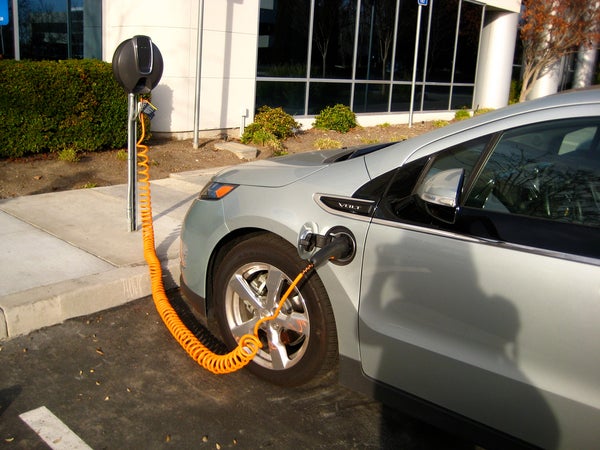
Instead, he suggested people were waiting for newer models. For example, General Motors Co. announced the second generation Chevrolet Volt, with an electric-only range of more than 50 miles compared to the previous range of less than 40, early last year. It was first introduced in 2010. Sales of the Leaf, the most popular EV, have stagnated among news of an imminent second-generation car.
"Every time we see a new and improved plug-in technology, there's this effect where first generation models tends to decline in anticipation of the next vehicle model," Shepard said. "You don't see that among conventional established markets because there's not a whole lot of improvement."
Shepard projects a record year for plug-in sales in Canada and the United States, driven by the introduction of new models. He expects sales to reach an optimistic 200,000, a 62 percent increase from last year.
Sales aren't on track to reach that so far. The introductions of the $30,000, 200-mile-range all-electric Chevrolet Bolt; the Prius Prime plug-in hybrid EV, which doubles the range of its predecessor; and the Mitsubishi Outlander plug-in hybrid EV, an SUV already popular in Europe, later this year could boost midmarket sales, he said. Sales of the Tesla Model X and second-generation Chevrolet Volt will also keep gathering steam, he suggested.
Nearly 400,000 people have already put in pre-orders for Tesla's 215-mile-range Model 3, which could sell for less than $30,000. It is expected at the end of 2017.
Reprinted from Climatewire with permission from Environment & Energy Publishing, LLC. www.eenews.net, 202-628-6500