

A flexible and transparent power source inspired by the electric eel could be used to power electrical devices in the body, such as cardiac pacemakers, implantable sensors or even prosthetic organs. The prototype, described in Nature on December 13, runs on a solution of salt and water, but researchers hope that future versions might get their energy from bodily fluids.
“Our artificial electric organ has a lot of characteristics that traditional batteries don't have,” says Thomas Schroeder, a chemical engineer at the University of Michigan in Ann Arbor, who co-led the research. As well as its desirable physical features, “it isn’t as potentially toxic, and it runs on potentially renewable streams of electrolyte solution”.
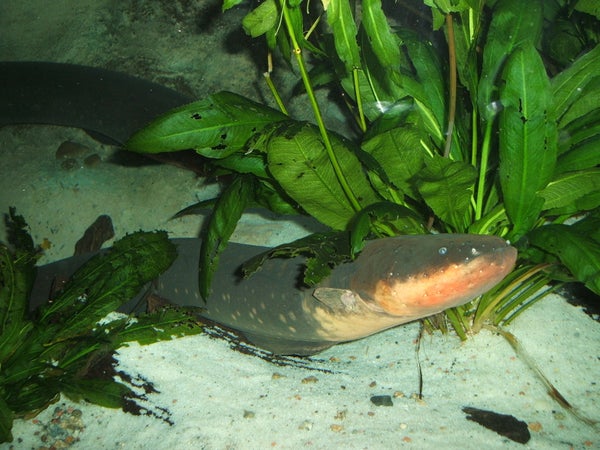
To design a biocompatible power source, Schroeder and his colleagues took inspiration from the knifefish, or electric eel (Electrophorus electricus), which defends itself and stuns prey with electrical discharges of up to 600 volts. The eel generates these powerful shocks using specialized cells called electrocytes, in organs that run along most of the length of its body. Variations in the concentration of electrolytes inside these cells generate a flow of ions that carries electric charge. Although each individual cell produces only a small voltage, eels have thousands of them stacked in series, so that all the voltages are added together.
On supporting science journalism
If you're enjoying this article, consider supporting our award-winning journalism by subscribing. By purchasing a subscription you are helping to ensure the future of impactful stories about the discoveries and ideas shaping our world today.
Piscine power
Schroeder’s team mimicked the anatomy of electrocytes using four different hydrogels made of polyacrylamide and water, then stacked around 2,500 of these units together. This synthetic system generated a potential difference of 110 volts. But its total power output was between two and three orders of magnitude smaller than that achieved by an electric eel, whose cells are thinner and thus lower-resistance.
In theory, the power generated by the artificial battery could be enough to run existing ultra-low-power devices, including some cardiac pacemakers, says Schroeder. But the team thinks it should be possible to improve the system’s performance dramatically, for example by making the hydrogel membranes thinner to reduce their resistance.
Electric eels use metabolic energy to sustain differences in electrolyte concentration between electrocytes. Schroeder hopes eventually to mimic that ability, too. “It's conceivable that we might someday be able to use a scheme like our artificial electric organ to tap into different fluids in the body,” he says.
Markus Buehler, a materials scientist and engineer at the Massachusetts Institute of Technology in Cambridge, is impressed by the team’s design. It is “an exciting advance that transcends conventional thinking”, he says. “I anticipate the deployment of this technology in the near future.”
This article is reproduced with permission and was first published on December 13, 2017.