
Bill Johnson is a utility executive, not a climate scientist.
That didn’t stop the Pacific Gas and Electric Co. CEO from wading into California’s complex climate conditions.
Noting that Northern California’s wildfire risk has grown exponentially in recent years, Johnson placed much of the blame on climate change, not PG&E’s compromised electricity grid.
On supporting science journalism
If you're enjoying this article, consider supporting our award-winning journalism by subscribing. By purchasing a subscription you are helping to ensure the future of impactful stories about the discoveries and ideas shaping our world today.
“As late as 2017, most people didn’t think [wildfire] risk was very high in Northern California, including the regulators,” Johnson said Wednesday during a briefing on PG&E’s latest intentional blackout to prevent wildfires.
“The risk has really accelerated, so we’re dealing with risk now with a [power] system that was really built for a different climate,” he added. “So these events for us, they don’t have anything to do with the quality of our system or vegetation management. They are pure weather-related, blowing stuff out of the forest into our lines; that’s really what the story is.”
Not exactly, experts say.
While warmer, drier air and drought are making the Sierra Nevada foothills and North Bay area ripe for more wildfires, other human factors are also elevating the region’s fire risk.
“It’s not accurate in an ecological sense that fire was never part of Northern California,” said Benjamin Cook, a Columbia University research scientist and expert on how climate change and other conditions affect wildfire risk in the West. “We’ve been doing a lot of other things over time that have made these fires worse.”
They include expanding development into fire-dependent ecosystems, decades of fire suppression that allowed unwise development in the “wildland-urban” interface and electricity grids that have stretched into forests without proper safeguards, regardless of local climate conditions.
“There’s several dimensions here,” said Cook. “Obviously, a very big issue is that people have been increasingly building in fire-prone areas. Where climate seems to be playing a role is that once these fires get going, they become bigger and spread faster.”
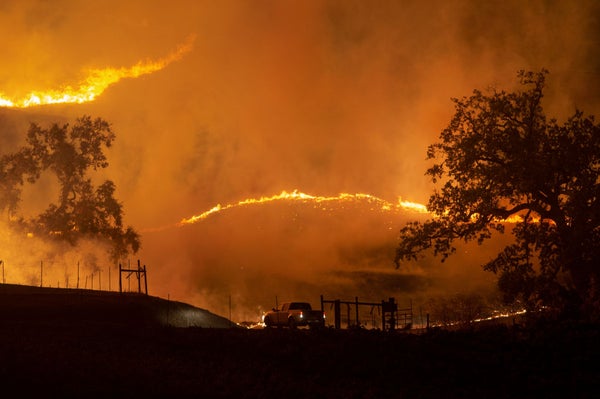
Just look at the Santa Rosa, Sonoma and Napa fires in 2017, followed by last year’s record-shattering Camp Fire that incinerated entire communities in Northern California and caused more than $25 billion in insured losses combined, according to state estimates.
Many of those properties didn’t exist 50 years ago, before California’s fast-growing population pushed into areas where fire may not have been an annual event but was common and even integral to the ecosystem. Fire suppression measures to protect homes and businesses did not reduce risk but increased it.
According to many scientists, climate change is the match that lit Northern California’s dramatically changed landscape. Short of retreat from high-risk wildfire areas, people will face rising risk as the climate continues to warm, experts say.
“I find myself wanting to squash statements that this is the ‘new normal,’” said Yana Valachovic, Northern California lead forest adviser for the University of California Cooperative Extension program. “You hear a lot of people promoting that idea, but I find it very defeating. It assumes an external force is operating on us in a way we can’t deal with.”
In fact, part of adapting to changing climate conditions in California involves understanding risks from wildfire and then making choices to reduce them. “Unfortunately, we’ve been very unaware and uninterested in how we can design, construct and maintain our homes,” Valachovic said.
‘Don’t know’ what to do
Even if people get smart about adaptive living in wildfire areas, the prospect of retrofitting an already built landscape would cost hundreds of billions of dollars, experts say. It would also create a wave of social and economic upheaval on par with the Dust Bowl of the 1930s, when 2.5 million people abandoned the Great Plains. Many of them moved West to California.
“I don’t know what we do about it. It’s kind of value judgments. If someone has lived in the Sierra foothills for decades and suddenly it burns down, they’re going to have a different perspective than someone else,” Cook said.
Utilities like PG&E, which date to the late 19th and early 20th centuries, should be more clear-eyed about how wind, drought and fire interact in a landscape like Northern California, experts say.
Rather than blame changes in the climate, experts say energy utilities should acknowledge their role in creating wildfire risk and seek ways to reduce risk without causing rolling blackouts that affect tens of millions of people.
“We believe that there are better solutions,” Aaron Kressig, a grid analyst for Western Resource Advocates, said in a recent blog post.
They include providing backup generators to communities and making bigger utility investments in microgrids powered by solar energy with battery storage to keep critical services online when fires rage.
“The physical world is changing due to the climate crisis, and utilities need to respond accordingly,” Kressig said.
PG&E says it is already deploying backup generation to high-risk areas with critical infrastructure. But as fires become larger and more dangerous, even backup generators can fail to meet essential power demand during blackouts. Traffic lights, cellphone service and gas pumps are rendered useless at the very time large-scale evacuations demand such services.
“Certainly there are a whole lot more of us in California today, and there’s a lot more developed [forest] edge than there was before, so it’s a lot harder to evacuate people to safe spaces quickly,” Valachovic said. “We’ve even been permitting single-access road communities. Clearly, we have not been interested in how to design our communities in the best way.”
Critics say utilities also play a role in poor planning decisions by following developers into unsuitable landscapes, but utilities are obligated by law to provide electric service within their service territories regardless of where homes are built. Even so, blackouts, planned or not, rip at a community’s sense of security just as much as other disasters, experts say.
Intentional blackouts can have cascading effects on other customers because of the interconnectivity of the grid.
“PG&E is holding Northern California hostage with its ham-handed, obscenely broad blackout,” state Sen. Scott Wiener, a Democrat from San Francisco, tweeted yesterday afternoon. “Enough is enough. We need structural reform.”
Reprinted from Climatewire with permission from E&E News. E&E provides daily coverage of essential energy and environmental news atwww.eenews.net.