
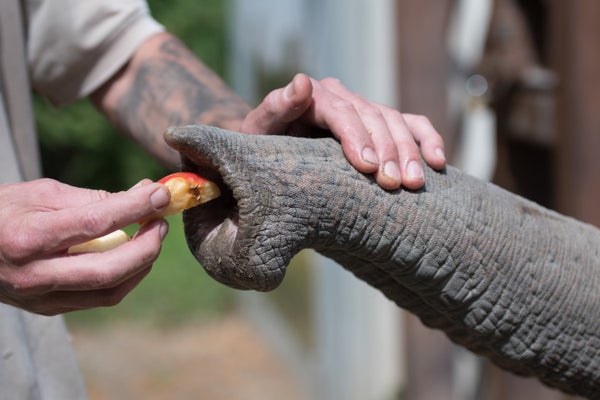
Watching an elephant forage for roots reveals both the strength and the sensitivity of its trunk. With more than 40,000 muscles, an elephant’s trunk can upend a tree and then gently collect the fragments that fell. It takes baby elephants nearly a year to master using their trunk in this way, and it’s taken humans even longer to understand how they’re able to do it. The secret may come down to elephants’ whiskers.
Researchers who analyzed the whiskers lining these animals’ trunks have discovered a unique structural property that helps elephants sense the world around them and determine whether a task calls for strength or sensitivity. In a study published in Science, the authors show that elephants’ whiskers—unlike the whiskers of other mammals—are more flexible at the tip and stiffer closer to the skin.
This observation helps scientists better understand elephants’ “umwelt,” or their individual sensory and perceptual experience of the world. “We found elephants are like aliens,” says Andrew K. Schulz, lead study author and a mechanical engineer at the Max Planck Institute for Intelligent Systems in Germany. “They have these hornlike whiskers with a [puzzling] stiffness gradient.”
On supporting science journalism
If you're enjoying this article, consider supporting our award-winning journalism by subscribing. By purchasing a subscription you are helping to ensure the future of impactful stories about the discoveries and ideas shaping our world today.
Because elephants have such rough, armorlike skin, investigators knew the whiskers on their trunks were probably doing a lot of sensory work to allow the animals to interact delicately with the world around them. But to truly understand these tiny filaments, they needed a much closer look. Alongside imaging and mechanical tests, Schulz and his colleagues used a CT scanner specially built for small objects to create a digital rendering of the elephant whiskers; this let the team analyze whisker structure from the inside out.

Armin Kritzinger/Getty Images
The part of the whisker closer to an elephant’s skin is very strong and porous, they found, whereas the tip’s material is denser and much more flexible. Wanting to understand the mechanics of this unique form, the team members 3D-printed a supersize version of a whisker with an accurate stiffness gradient to feel for themselves.
“I was walking down the hallway and hitting things [with the whisker], and I had this true eureka moment,” says Katherine J. Kuchenbecker, senior author of the study and director of the haptic intelligence department at the Max Planck Institute for Intelligent Systems. She noticed that hitting something hard with the stiff base of the whisker felt much more solid and crisp than hitting something with the softer tip, giving her a sense of the object without her skin even touching it.
Elephants use their trunks to breathe, smell, grab things, communicate and even perceive objects outside their line of sight. And their whiskers help to shape these experiences. “Nearly every mammal—not just elephants—has whiskers whose size, shape and material properties are almost certainly adapted to the way that species uses touch in its environment,” explains Mitra Hartmann, a biomedical and mechanical engineer at Northwestern University, who was not involved in the study.
Schulz and his team incorporated their data into a tool kit for researchers in other fields to explore. They are particularly interested in seeing how materials with a similar stiffness gradient could be applied to robotics. Maintaining machines’ strength while making them soft enough to avoid damaging the materials they interact with is a major robotics challenge.
“This study is a fabulous example of interdisciplinary science,” says John Hutchinson, a biologist at the University of London’s Royal Veterinary College. “It is elegant neuroscience, anatomy and mechanics.”