
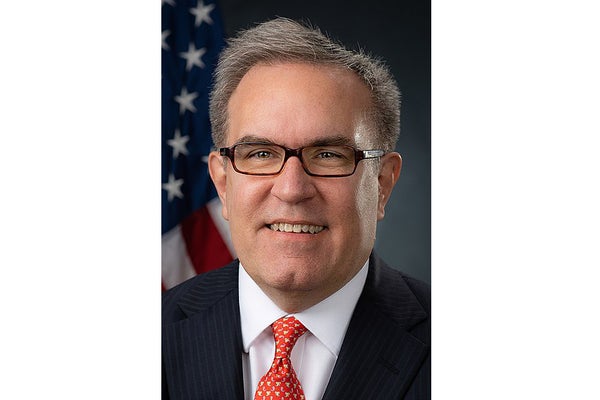

U.S. Environmental Protection Agency (EPA) Administrator Scott Pruitt has resigned after a tumultuous 17 months in office. His deputy, Andrew Wheeler, is taking over as acting director. Wheeler is a career consultant, energy lobbyist and political aid.
Pres. Donald Trump announced Thursday on Twitter Pruitt would be resigning from the post, making Wheeler the newest chief of the nearly 50-year-old agency. Just a few hours before the announcement the EPA had released a draft rule on coal plants to replace the Obama-era Clean Power Plan.
Pruitt has been embroiled in controversy throughout his short tenure as EPA chief. Reports have described above-average expenses that include first-class travel, a 24/7 security detail and, recently, $10,200 in costs associated with his upgrade to a larger SUV. Reports also indicate Pruitt asked EPA staff to run personal errands for him not pertaining to the agency’s responsibilities and he has had close ties with industry giants the agency has previously regulated.
On supporting science journalism
If you're enjoying this article, consider supporting our award-winning journalism by subscribing. By purchasing a subscription you are helping to ensure the future of impactful stories about the discoveries and ideas shaping our world today.
Although Pruitt has long been known for his high-profile appearances dating back to his successful run for Oklahoma attorney general, reports paint Wheeler as a quieter political actor. The latter’s career traces back to the EPA, where he worked in its Office of Pollution Prevention and Toxics in Pres. George H. W. Bush’s administration. He went on to work as chief of staff to Sen. James Inhofe, a Republican from Oklahoma who infamously brought a snowball onto the Senate floor in an effort to illustrate his point that there is no unprecedented climate change.
Wheeler worked under Inhofe for about a dozen years, according to The New York Times, and is among a growing number of former Inhofe staffers now employed by the EPA. “They’re all good people,” Inhofe told the Times. “I trained them well.”
After his work with Inhofe, Wheeler transitioned into a lobbying role with Murray Energy—a company that had a history with Pruitt. In summer 2015 representatives of Murray attended a conference of the Republican Attorneys General Association and held a 40-minute meeting with attendees including Pruitt, schedules of the meeting show. In the weeks following Trump’s inauguration the company’s chief executive provided Trump with a list of regulations he hoped to see removed from the coal industry (pdf).
The list of regulations opens with a letter addressed to Vice Pres. Mike Pence that states: “Enclosed is an Action Plan for the Administration of President Donald J. Trump, which will help in getting America’s coal miners back to work.” The recommendations include a 50 percent cut to the EPA staff, and U.S. withdrawal from the Paris climate change agreement—which Trump already initiated.
Wheeler was photographed in a meeting with Murray’s owner, along with Department of Energy Secretary Rick Perry, in the last few days of March 2017.
Before Wheeler took on the post as Pruitt’s second-in-command, he was a principle consultant for FaegreBD Consulting. He spent about nine years working for the company, where—according to his LinkedIn profile—he helped “lead the firm’s practice by advising numerous types of clients on comprehensive legislative, regulatory and operational strategies to best prepare for a carbon-constrained future.”
After Pruitt’s resignation, all eyes are on Wheeler.