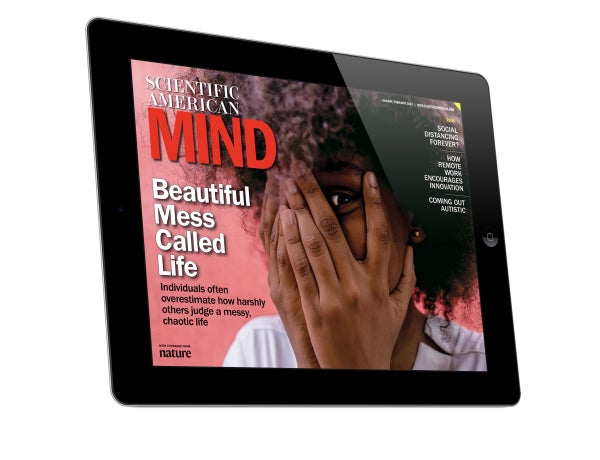
Embracing the Mess

Individuals often overestimate how harshly others judge a messy, chaotic life

Scientific American MIND, Jan-Feb 2022

Scientific American MIND, Jan-Feb 2022

Join Our Community of Science Lovers!

The pandemic has been a hard time for most people, even if not everyone is struggling in the same way. Families, for example—mothers in particular—had to shift their routines drastically to accommodate remote schooling schedules for kids, which disrupted daily life in big ways. Several of my mom friends lamented to me repeatedly that they felt shame about giving their children the iPad to occupy them or letting them watch inordinate amounts of TV so the adults could get their own tasks done (or just have a break!). Pandemic aside, parenting seems to be one area where people are worried that others must think they’re a “bad mom” or “bad dad” for not adhering to some idea of perfection. But as social psychologist Anna Bruk writes in the cover story, our so-called messy lives aren’t really noticed by outsiders. And giving yourself a high dose of self-compassion is a tried-and-true way to relax about an imperfect—and sometimes chaotic—existence (see “Other People Don’t Think You’re a Mess”).

Elsewhere in this issue, check out the surprising ways that the sound of our voice affects how we perceive ourselves (see “A Change to the Sound of the Voice Can Change Your Very Self-Identity”) and a report from senior editor Gary Stix on whether we’ll ever want to get close to people again (see “COVID Expanded the Boundaries of Personal Space—Maybe for Good”). Yes, life has been exceptionally unsettling lately, but it’s the only one we’ve got.

Andrea Gawrylewski is chief newsletter editor at Scientific American. She writes the daily Today in Science newsletter and oversees all other newsletters at the magazine. In addition, she manages all special editions and in the past was the editor for Scientific American Mind, Scientific American Space & Physics and Scientific American Health & Medicine. Gawrylewski got her start in journalism at the Scientist magazine, where she was a features writer and editor for "hot" research papers in the life sciences. She spent more than six years in educational publishing, editing books for higher education in biology, environmental science and nutrition. She holds a master's degree in earth science and a master's degree in journalism, both from Columbia University, home of the Pulitzer Prize.

More by Andrea Gawrylewski
SA Mind Vol 33 Issue 1This article was published with the title “Embracing the Mess” in SA Mind Vol. 33 No. 1 (), p. 2
doi:10.1038/scientificamericanmind0122-2

It’s Time to Stand Up for Science

If you enjoyed this article, I’d like to ask for your support. Scientific American has served as an advocate for science and industry for 180 years, and right now may be the most critical moment in that two-century history.

I’ve been a Scientific American subscriber since I was 12 years old, and it helped shape the way I look at the world. SciAm always educates and delights me, and inspires a sense of awe for our vast, beautiful universe. I hope it does that for you, too.

If you subscribe to Scientific American, you help ensure that our coverage is centered on meaningful research and discovery; that we have the resources to report on the decisions that threaten labs across the U.S.; and that we support both budding and working scientists at a time when the value of science itself too often goes unrecognized.

In return, you get essential news, captivating podcasts, brilliant infographics, can't-miss newsletters, must-watch videos, challenging games, and the science world's best writing and reporting. You can even gift someone a subscription.

There has never been a more important time for us to stand up and show why science matters. I hope you’ll support us in that mission.

Thank you,

David M. Ewalt, Editor in Chief, Scientific American

Subscribe