
Billions of years ago the single-celled common ancestor of all life on earth split into bacteria and archaea, according to evolutionary theory. Now scientists have genetically engineered a microbe that combines features of both domains, offering insight into how this pivotal event occurred.
Bacteria and archaea are both unicellular organisms that lack nuclei, but they have distinct genetic and chemical makeups. Their cell membranes, for example, are made up of two different kinds of fatty molecules, known as lipids. A long-standing hypothesis for the split between these domains is that their common ancestor's membrane contained both lipids, making it unstable and perhaps leaky—and less evolutionarily favorable.
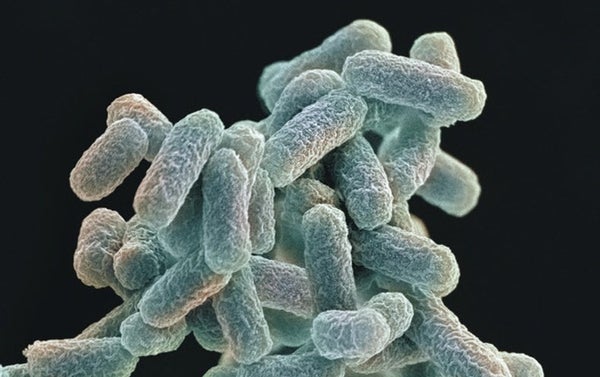
Microbiologists in the Netherlands decided to test this notion by re-creating a primitive organism with a hybrid-lipid membrane. They spliced the gene for archaeal lipids into Escherichia coli bacteria, then modified the organisms' metabolism to boost production of molecules needed to make these lipids. The resulting E. coli strain had cell membranes containing up to 30 percent archaeal lipids and 70 percent bacterial ones, the researchers reported in April in the Proceedings of the National Academy of Sciences USA.
On supporting science journalism
If you're enjoying this article, consider supporting our award-winning journalism by subscribing. By purchasing a subscription you are helping to ensure the future of impactful stories about the discoveries and ideas shaping our world today.
To the team's surprise, the new cells grew successfully, and the mixed membranes were stable. This “tips the scales toward other historical causes for the archaea-bacteria separation,” says Eugene Koonin, an evolutionary and computational biologist at the National Institutes of Health, who edited the paper for the journal.
One alternative, says study co-author Arnold Driessen of the University of Groningen, is that there was not one common ancestor “but a mixture of multiple life-forms.” A more bizarre scenario, Driessen says, is that the ancestor had no membrane but was “just a soup protected by clay particles.”