
On supporting science journalism
If you're enjoying this article, consider supporting our award-winning journalism by subscribing. By purchasing a subscription you are helping to ensure the future of impactful stories about the discoveries and ideas shaping our world today.
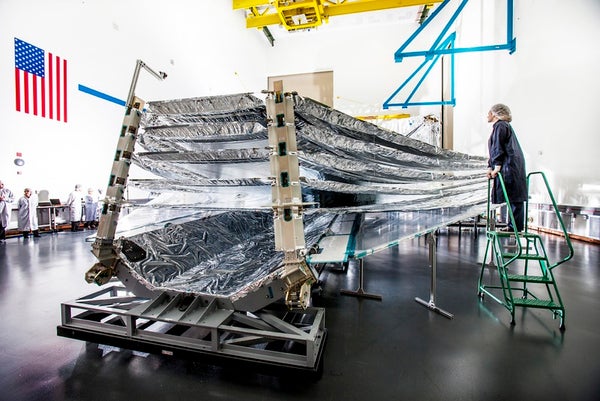
For car owners, manipulating the folds and creases of those unwieldy sunshades that spread underneath hot windshields can be tricky. But for NASA, unfolding a shade the size of a tennis court 1.6 million kilometers away in space is astronomically more complicated. Seven engineers and six technicians at Northrop Grumman in Redondo Beach, Calif., conducted a three-day test of the giant sunshield that will protect NASA’s James Webb Space Telescope once it is irretrievably flung into orbit. The team spent 20 hours in July unfolding and separating the shield’s five test layers for the first time to simulate how it will unfurl in space.
The apparatus—made of hair-thin membrane layers composed of a strong, lightweight plastic that is coated with a reflective metal—will act as a giant umbrella. It will partition the observatory into a warm sun-facing side, which can reach a sweltering 200 degrees Celsius, and a cold, dark side. The device will shield the telescope’s sensitive instruments with a whopping sun protection factor (SPF) of 1,000,000.
This and other tests will confirm that the shade is working properly and alert scientists to any issues. To compensate for the gravity during the test—which will not be present in orbit—the team rested the shield on beams to support the shield’s weight. On launch the giant shade will be wrapped around the Webb telescope’s mirrors and instruments. Once the package has reached orbit it will unfold as programmed. The observatory is set to launch in October 2018.
—Julia Calderone