

The Supreme Court battle isn't the only fiercely partisan confirmation fight looming ahead for the Senate.
EPA Administrator Scott Pruitt's resignation yesterday came shortly after Justice Anthony Kennedy announced his retirement this month from the Supreme Court, setting up the Senate for two highly charged confirmation tussles just four months before midterm elections.
Pruitt was confirmed last February on a largely partisan 52-46 vote. But a Senate vote on his successor could be even more polarizing because senators will be juggling fewer nominations and will have more time to focus on the nominee's record, said Norman Ornstein, a resident scholar at the American Enterprise Institute.
On supporting science journalism
If you're enjoying this article, consider supporting our award-winning journalism by subscribing. By purchasing a subscription you are helping to ensure the future of impactful stories about the discoveries and ideas shaping our world today.
It's still unclear when President Trump plans to nominate a replacement and how quickly the Senate Environment and Public Works Committee would consider the nomination.
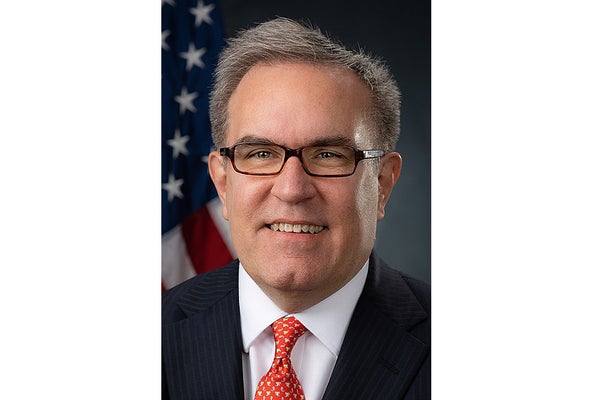
EPA Deputy Administrator Andrew Wheeler will become the agency's acting leader next week. He's expected to be in the role for a while, and some expect Trump to formally pick him for the job.
Democrats and environmental groups are already hammering Wheeler for his connections to the energy industry. He has worked as a lobbyist for coal giant Murray Energy Corp. However, he had pledged in a recusal statement to avoid issues he lobbied on to EPA and other federal agencies for eight of his former clients, including Murray Energy (Climatewire, July 2).
Even though the EPA pick will be controversial, it will still not garner the same degree of attention as the hunt for Kennedy's replacement, a nomination that will consume much of the Senate's attention.
"We are going to see a bigger battle in the Supreme Court; it's very, very likely we'll see someone in place at the Supreme Court before EPA," Ornstein said. "[EPA] ought to be as important — we're talking about the planet here — but it won't be. It's not the hot button that Roe v. Wade is."
As an acting administrator, Wheeler will wield the same policymaking authority as his Senate-confirmed counterpart, though he perhaps may be less likely to strike out on new priorities at the agency, at least at first, according to some former EPA employees.
Wheeler can stay in his position for 210 days under the Federal Vacancies Reform Act of 1998. That time can be extended longer depending on when Trump decides to nominate a replacement. Wheeler can stay in his post while the Senate considers up to two rounds of nominees for the position. If the Senate rejects a second nominee, then the president will have to nominate a new acting administrator (Climatewire, June 25).
If Trump takes his time in nominating a replacement and the Senate takes its time reviewing a replacement, EPA might not have a Senate-confirmed administrator until well into 2019.
Joe Edgell, president of National Treasury Employees Union Chapter 280 — which represents EPA employees — suggested it's possible the president won't appoint a new administrator at all and might simply allow Wheeler to continue in an acting capacity.
"Should there be a nomination, I cannot imagine that it would get any traction on the Hill until after the midterm elections," Edgell said in an email.
Replacement prospects
David Schnare, a former EPA transition team member who has been publicly critical of Pruitt, nonetheless described Pruitt's resignation as a sad, but inevitable, event.
Schnare speculated that Donald van der Vaart, the former secretary of the North Carolina Department of Environmental Quality, could be a possible contender for permanent administrator. Van der Vaart's name had previously been under consideration for a position within the Trump administration.
Other names previously circulated for the post include EPA's air chief, Bill Wehrum; the chairman of the Texas Commission on Environmental Quality, Bryan Shaw; and the head of the Ohio EPA, Craig Butler (Climatewire, March 15).
"Democrats aren't going to make it easy. It's not going to happen anytime soon," Schnare said of the nomination.
While Pruitt's exit had long been anticipated, yesterday's announcement came with little warning, even to EPA's own staff.
A spokesman for Senate Majority Leader Mitch McConnell's (R-Ky.) office declined to comment on a nomination that hasn't yet been made by the president. The offices of the majority and minority leaders of the Senate Environment and Public Works Committee also did not return requests for comment on how quickly they anticipate the nomination process will proceed.
But Sen. Tom Carper of Delaware, the top Democrat on the EPW panel, cheered Pruitt's exit soon after the president's tweet about it.
"Hopefully, with Mr. Pruitt's resignation, we can finally return to more responsible leadership at EPA and an agency that can get back to doing its important work of protecting the American people rather than the highest bidder," he said in a statement.
Reprinted from Climatewire with permission from E&E News. E&E provides daily coverage of essential energy and environmental news at www.eenews.net.