
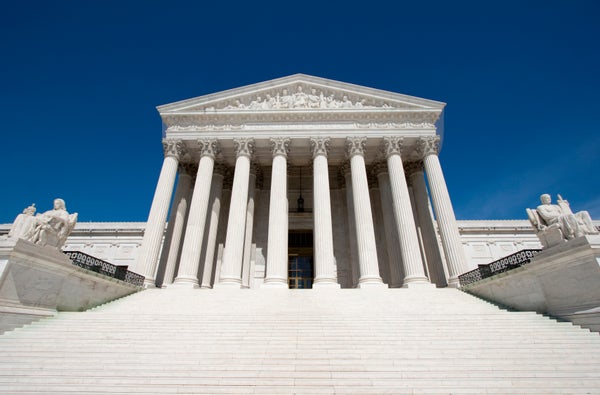
Environmentalists want the Supreme Court to reconsider its unprecedented decision 2 ½ years ago to stay the Clean Power Plan.
Attorneys for a coalition of green groups Friday asked Chief Justice John Roberts to force opponents of the plan to explain why the stay should continue. The Supreme Court halted implementation of the rule in February 2016 on a 5-4 vote; it was the late Justice Antonin Scalia’s last action on the court.
In their letter, the environmentalist groups cited the frustration expressed by some judges on the U.S. Court of Appeals for the District of Columbia Circuit that the stay, combined with litigation delays in the lower court, has allowed EPA to circumvent its duties to regulate greenhouse gases.
On supporting science journalism
If you're enjoying this article, consider supporting our award-winning journalism by subscribing. By purchasing a subscription you are helping to ensure the future of impactful stories about the discoveries and ideas shaping our world today.
A full panel of D.C. Circuit judges heard oral arguments over the rule in September 2016 but never issued any decision on its legality. The D.C. Circuit agreed to halt litigation in April 2017 and has since issued orders extending the hold.
“The litigation has come to a protracted standstill with the support of the parties that sought a stay in this Court,” the environmentalists wrote to Roberts. “In light of these changed circumstances, the Court may wish to require the parties to explain why the stay should continue in effect.”
The coalition includes the Environmental Defense Fund, Natural Resources Defense Council, Sierra Club and Center for Biological Diversity.
The letter comes as the Trump administration last week informed the court that it will not complete a replacement for the 2015 Obama rule until at least early next year. EPA has asked the D.C. Circuit to keep the case in abeyance as it completes work on the proposal (Climatewire, July 27).
Some judges are getting impatient with the administration’s timeline for revising the rule, as the environmentalists noted in their letter.
In June, as the D.C. Circuit granted the administration’s latest request to stay the litigation while it works on the replacement, two Obama-appointed judges warned it would be the last time they agree to such a delay.
“Petitioners and EPA have hijacked the Court’s equitable power for their own purposes,” Judge Robert Wilkins wrote in a statement joined by Judge Patricia Millett.
Judge David Tatel, a Clinton appointee, wrote in a separate statement that the Supreme Court’s stay has given EPA “indefinite license” to avoid complying with its statutory duty to address greenhouse gases (Greenwire, June 26).
Reprinted from Climatewire with permission from E&E News. E&E provides daily coverage of essential energy and environmental news at www.eenews.net.