
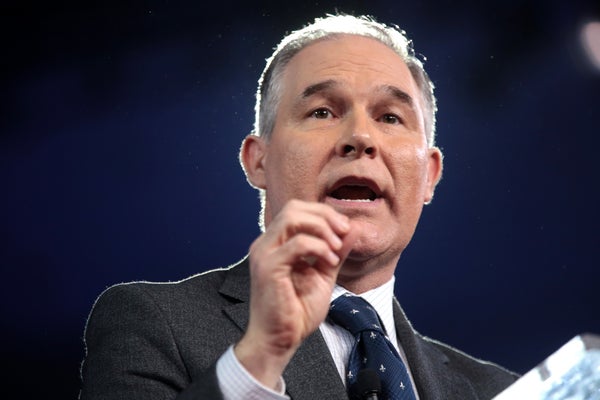
The head of the US Environmental Protection Agency (EPA) has announced that the backlog of new chemicals that were stuck in the agency’s review processes has been eliminated. The news has attracted both praise and criticism.
The updated Toxic Substances Control Act (TSCA), which regulates new and existing chemicals in the US, mandates that the EPA review chemicals submitted to the agency for approval and make a safety determination prior to them being able to enter the marketplace. There are typically about 300 such reviews ongoing within the EPA at any given time, but the logjam had increased to over 600 when Scott Pruitt took the agency’s helm in February.
‘By the end of 2016, there was a 600-case backlog that was on top of the typical 300 new chemical cases under review at any given time, so we had about 900 cases we had not yet made a determination about,’ explainsJeff Morris, who directs the EPA’s Office of Pollution Prevention and Toxics, adding that they receive more than 100 cases each month.
On supporting science journalism
If you're enjoying this article, consider supporting our award-winning journalism by subscribing. By purchasing a subscription you are helping to ensure the future of impactful stories about the discoveries and ideas shaping our world today.
Now, the number of these new chemical safety reviews at the EPA is back to the typical baseline of about 300, mostly due to the agency dedicating more manpower to completing these assessments. Morris says the EPAdoubled its scientific staff devoted to the review of new chemicals by temporarily diverting staff working on existing chemicals, and the agency also tripled the number of weekly meetings convened to address new chemical notices.
The American Chemistry Council, the US chemical industry’s trade group, praised the EPA for addressing the logjam as ‘a critical step’ that ‘shows realand deliberate progress,’. The Society of Chemical Manufacturers and Affiliates (SOCMA) also applauded the EPA for clearing the backlog. ‘A fully functioning new chemicals programme under [TSCA]…is crucial in helping our members remain competitive in the global market,’ said SOCMA’s managing director of government relations, Robert Helminiak.
However, Richard Denison, lead senior scientist with the Environmental Defense Fund, argues that Pruitt’s EPA is trying to circumvent the requirements of the new TSCA law in the name of increasing programme ‘throughput’. He is concerned that the agency is moving away from the law’s clear requirements that the EPA rigorously review both intended and reasonably foreseen uses of new chemicals. But Morris says that new chemical reviews continue to get ‘the same level of rigour’.
Lynn Bergeson, a managing partner with the Washington, DC-based law firm Bergeson & Campbell that advises chemical companies about regulatory compliance, is enthusiastic about the developments. ‘This means that those new chemical notifications that were captured and subjected to the review procedures set out under the new TSCA law have now been cleared,’ she tells Chemistry World.
The 600 or so cases that have now been reviewed were ‘kind of held hostage’ by the updated TSCA, Bergeson says. She applauds the EPA for ‘expending extraordinary effort’ to get them through the system.
This article is reproduced with permission from Chemistry World. The article was first published on August 10, 2017.