
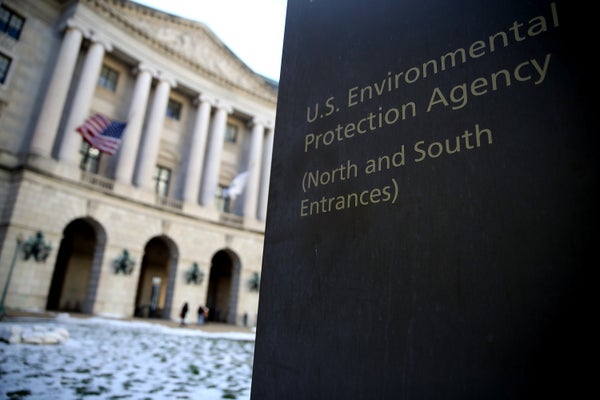
EPA’s Science Advisory Board wants to review Administrator Scott Pruitt’s plan to restrict studies the agency uses when crafting regulations.
The board is now led by a Pruitt appointee, Michael Honeycutt, who signed off on the request for more discussion on Pruitt’s plan to limit the agency’s use of scientific studies to those that use public data.
In a May 12 memo, members of an SAB working group flagged potential problems with the rule and determined that it could affect regulations by making them more or less stringent. They wrote that they learned of the proposed rule from news articles and the Federal Register and noted that EPA did not provide a description of the proposed action.
On supporting science journalism
If you're enjoying this article, consider supporting our award-winning journalism by subscribing. By purchasing a subscription you are helping to ensure the future of impactful stories about the discoveries and ideas shaping our world today.
EPA is required by law to provide the SAB with “proposed criteria documents, standards, limitations, or regulations provided to any other Federal agency for formal review and comment, together with relevant scientific and technical information on which the proposed action is based,” the group said in the memo.
Among the criticisms was that the agency appears to have developed the rule without consulting actual researchers.
“The precise design of the rule appears to have been developed without a public process for soliciting input from the scientific community,” the group wrote. “Nor does the preamble to the rule describe precisely how the proposal builds on previous efforts to promote transparency such as the Information Quality Act and EPA’s Information Quality Guidelines.”
The proposed rule is based on legislation by Rep. Lamar Smith (R-Texas), chairman of the House Science, Space and Technology Committee. Pruitt adopted Smith’s legislation, once known as the “Secret Science” bill, after it passed the House multiple times but failed to make it through the Senate. Smith and other proponents of the legislation say it’s necessary to increase accountability in science used in regulations that can have an economic impact.
Critics say it’s designed to eliminate consideration of major health studies that form the backbone of the Clean Air Act and air pollution provisions. One of the targets of the proposed rule is widely considered to be the Harvard Six Cities Study, a groundbreaking body of research that connected air pollution to significant health problems.
The researchers wrote in their memo that the Harvard study has been reviewed multiple times, by researchers who did not have access to its underlying data but came to similar conclusions.
“EPA’s Science Advisory Board plays an important role in informing EPA actions on policy and regulatory matters,” an EPA spokesman said. “We value the Board’s expertise, and we welcome feedback from the chartered panel on areas in which they are interested in getting additional scientific information that is relevant to the rulemaking process.”
The SAB working group found that the proposed rule did not ascertain the effect of data restrictions on existing regulations, nor did it consider the costs of imposing such a program. The researchers acknowledged that some scientific disciplines need more transparency but said the field has already been moving in that direction. They noted that many human health studies are conducted with the condition and agreement that the subject’s confidentiality will be protected. They wrote that the proposed rule might be better applied to future studies, rather than those that are already in use at the agency.
“The Work Group also found that the rule is highly controversial (indeed a similar legislative effort in the House has been stalled in Congress for several years) and could have long-term implications,” they wrote. “Furthermore, the rule could have the effect of removing legal, ethical, and peer-reviewed studies of health effects as sources to support the agency’s regulatory efforts.”
The researchers noted that EPA already has “mechanisms for vetting science through several expert panels,” including the SAB itself. They also requested that EPA provide a scientific and technological basis for its proposed actions.
Reprinted from Climatewire with permission from E&E News. E&E provides daily coverage of essential energy and environmental news at www.eenews.net.