
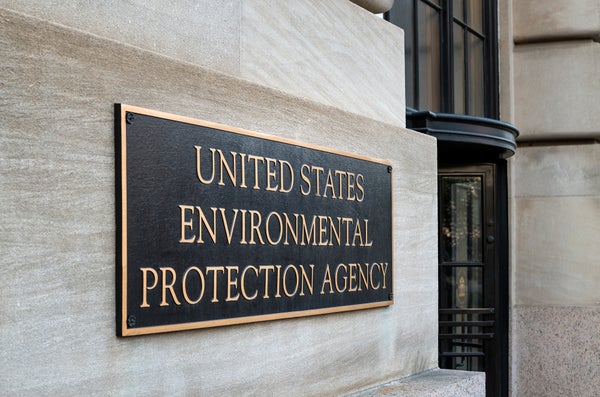
The U.S. EPA Science Advisory Board has not met in at least six months, and some of its members say it's being sidelined to avoid getting in the way of agency Administrator Scott Pruitt's anti-regulatory agenda.
Agency officials say the lapse isn't intentional and that it's just the result of delayed paperwork. That has prevented the group from meeting because there weren't enough members to make a quorum.
The board, which typically has about 45 members, is tasked by Congress to evaluate the science used by EPA to craft policy. The full board has not met since August, nor has it had any conference calls or votes. In the past, members would have had multiple interactions during that time period, said William Schlesinger, a board member who is an emeritus professor of biogeochemistry at Duke University.
On supporting science journalism
If you're enjoying this article, consider supporting our award-winning journalism by subscribing. By purchasing a subscription you are helping to ensure the future of impactful stories about the discoveries and ideas shaping our world today.
"I guess the Science Advisory Board still exists; I guess I'm still on it," he said. "I think the answer is maybe they're giving it what we used to call the 'pocket veto': If you don't meet, then the scientists are not a pain, because they don't have a forum."
EPA officials disputed that characterization. The full board has not had a quorum and therefore could not meet, said Michael Honeycutt, who heads the board. Subcommittees have met in that time. He blamed the delay on the government's bureaucratic human resources process and said the official start date for many new members was Feb. 18. He expects to have a meeting at the end of May or in June.
"They have had to onboard a larger number this time than they have in the past, but the HR people have just been working furiously because there is a lot of paperwork you have to fill out about all your stock holdings, just to make sure they can tell you 'Yes, you can participate in this, but you can't participate in that,'" Honeycutt said.
Pruitt revamped the science advisory boards in October, increasing industry representation. Scientists who received past EPA grants for research are now considered to have conflicts of interest, a sharp change from tradition. Critics complain that the rule changes will force out independent academics while favoring industry researchers whose work is often used to fight regulations. Pruitt is expected to eventually appoint a majority of industry-allied researchers on the boards.
The lapse in board action is fueling concern among current members who see it as an attempt by Pruitt to stack the panel with industry researchers, said one sitting member who did not wish to be identified for fear of retaliation. The board member said Pruitt is slowing down the advisory panel's actions until the terms of about a dozen members expire at the end of September.
"He's running out the clock, because in the end of September, he gets another chunk of them off," the member said. "The obvious interpretation is that he's making sure he doesn't use the SAB until he has appointed the overwhelming majority of the people on the SAB."
In the past, the board would have held at least one two-day meeting and two or three teleconferences in a six-month period, said Peter Thorne, a professor at the University of Iowa College of Public Health who spent six years on SAB, including two as chairman. EPA officials also would have sought briefings to detail scientific findings behind regulations.
"If there are reports or regulatory actions that are being scheduled or that are happening and they're not coming to the science advisory board, then something is most definitely lost, because the board provides very important input to the process and scientific rigor," Thorne said.
One of the final issues that board members were examining before their activity stopped is whether woody biomass should be considered a carbon-neutral fuel, Schlesinger said. Pruitt recently traveled to New Hampshire, where he met with members of the forest products industry and tweeted that EPA now considers biomass to be carbon-neutral. It's a hotly contested issue that has been debated for about a decade, sometimes sharply dividing the science board.
Pruitt released a list yesterday of his accomplishments since taking the helm of EPA. Declaring that woody biomass is carbon-neutral was included on the list.
Schlesinger said he's concerned that Pruitt will stack the board with dissenting voices to create uncertainty in science where it might not exist.
"If a subcommittee working on a particular issue had enough industry people and naysayers cast enough doubt, the report that went back to the administrator would be rather vague; it would be equivocal, probably not be the basis for taking action," he said. "And a lot of times, that is what the industry wants on a subject: no change or minimal regulation."
Reporter Corbin Hiar contributed.
