
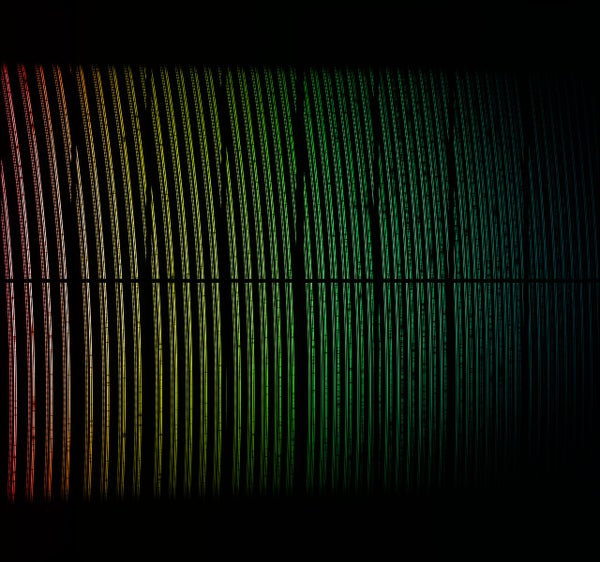
A powerful new planet hunter has begun searching the heavens for rocky, potentially habitable worlds.
The ESPRESSO instrument, which is installed on the European Southern Observatory's Very Large Telescope (VLT) in northern Chile, made its first observations last month, project team members announced today (Dec. 6).
ESPRESSO is designed to find alien planets via the "radial velocity" method—that is, by detecting the tiny wobbles in a star's movement caused by the gravitational tug of orbiting planets. The instrument is the next-generation version of the prolific HARPS spectrograph, which has discovered more than 100 exoplanets to date. [7 Ways to Discover Alien Planets]
On supporting science journalism
If you're enjoying this article, consider supporting our award-winning journalism by subscribing. By purchasing a subscription you are helping to ensure the future of impactful stories about the discoveries and ideas shaping our world today.
Only NASA's famous Kepler space telescope, which looks for the tiny brightness dips caused when planets cross their star's face, has found more alien worlds than HARPS. (The gap between the two is pretty big, however: Kepler's tally currently stands at 2,515 planets across its two missions, along with 2,500 or so additional "candidates" awaiting confirmation by follow-up studies or observations.)
"ESPRESSO isn't just the evolution of our previous instruments like HARPS, but it will be transformational, with its higher resolution and higher precision," project lead scientist Francesco Pepe, of the University of Geneva in Switzerland, said in a statement.
Just how precise will ESPRESSO (whose name is short for Echelle SPectrograph for Rocky Exoplanet and Stable Spectroscopic Observations) actually be? Project team members are aiming for a velocity-measurement precision of just a few centimeters (1 inch or so) per second, compared with the 1 meter (3.3. feet) per second capability of HARPS. ESPRESSO should therefore be able to spot some of the smallest planets ever found, ESO representatives said.
Part of the improvement is due to technology advances, and part owes to ESPRESSO's placement on a much larger telescope, team members said.

Image showing the room where the light beams coming from the four Very Large Telescope "unit telescopes" are brought together and fed into fibers, which in turn deliver the light to the ESPRESSO spectrograph itself in another room. One of the points where the light enters the room appears at the back of this picture. Credit: ESO/P. Horálek
HARPS sits on an 11.8-foot (3.6 m) scope at ESO's La Silla Observatory, which is also in Chile. The VLT consists of four 26.9-foot-wide (8.2 m) "unit telescopes"—and ESPRESSO will be linked to all of them, achieving the light-collecting equivalent of a single 52.5-foot-wide (16 m) scope, ESO representatives said.
"This success is the result of the work of many people over 10 years," Pepe said. "ESPRESSO will be unsurpassed for at least a decade. Now I am just impatient to find our first rocky planet!"
EDITOR'S RECOMMENDATIONS
Copyright 2017 SPACE.com, a Purch company. All rights reserved. This material may not be published, broadcast, rewritten or redistributed.