Essential Links in the Immunity Web

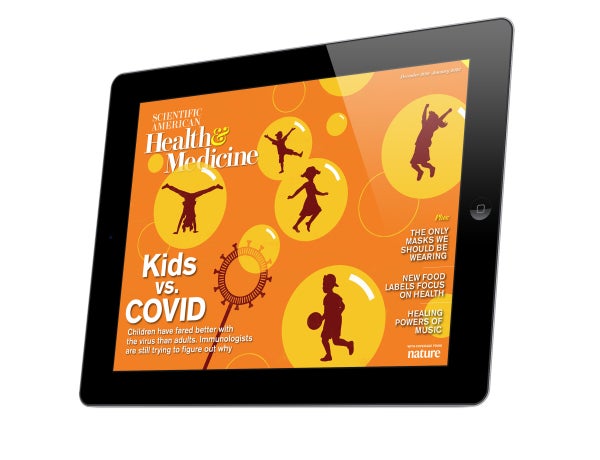
Children have fared better with the virus than adults. Immunologists are still trying to figure out why

SA Health & Medicine, December 2021

SA Health & Medicine, December 2021

Join Our Community of Science Lovers!

Beginning in about January of this year, when the first COVID-19 vaccines started becoming available to essential workers and then, within the next few months, to most all adults, friends of mine with young children started asking me: “When will my kids be able to get it?” As the months rolled on, I tried to give them the best guess I could, based on our latest reporting, and by picking my colleagues’ brains at Scientific American and other publications. Keeping schools closed for fear of mass outbreaks of the virus was also keeping parents at home and also worrying parents who, despite being vaccinated themselves, didn’t want to unwittingly give the virus to their children.

Finally, in early November, the CDC authorized a pediatric vaccine for kids ages five to 11. It seems a major step toward ending the pandemic and resuming a new normal kind of life. To be sure, the pediatric vaccine protects kids, but it will also lower transmission rates of the virus to any adults the children are in contact with. And perhaps that is the most vital side effect of a new wave of immunizations. As Smriti Mallapaty writes in this issue, children have always shown stronger immunity again SARS-CoV-2, for reasons that researchers are still parsing (see “Why Kids Beat Back COVID Better Than Adults”). But by vaccinating the nearly 30 million youngsters who are now eligible, we are lowering the chance that they’ll be potential vectors for the virus and pass it to adults and vulnerable people. If the endgame is to destroy the web of coronavirus transmission, this is a big win.

Andrea Gawrylewski is chief newsletter editor at Scientific American. She writes the daily Today in Science newsletter and oversees all other newsletters at the magazine. In addition, she manages all special editions and in the past was the editor for Scientific American Mind, Scientific American Space & Physics and Scientific American Health & Medicine. Gawrylewski got her start in journalism at the Scientist magazine, where she was a features writer and editor for "hot" research papers in the life sciences. She spent more than six years in educational publishing, editing books for higher education in biology, environmental science and nutrition. She holds a master's degree in earth science and a master's degree in journalism, both from Columbia University, home of the Pulitzer Prize.

More by Andrea Gawrylewski
SA Health & Medicine Vol 3 Issue 6This article was published with the title “Essential Links in the Immunity Web” in SA Health & Medicine Vol. 3 No. 6 ()
doi:10.1038/scientificamerican122021-4yKHFGldUucBBwHAByyx2e

It’s Time to Stand Up for Science

If you enjoyed this article, I’d like to ask for your support. Scientific American has served as an advocate for science and industry for 180 years, and right now may be the most critical moment in that two-century history.

I’ve been a Scientific American subscriber since I was 12 years old, and it helped shape the way I look at the world. SciAm always educates and delights me, and inspires a sense of awe for our vast, beautiful universe. I hope it does that for you, too.

If you subscribe to Scientific American, you help ensure that our coverage is centered on meaningful research and discovery; that we have the resources to report on the decisions that threaten labs across the U.S.; and that we support both budding and working scientists at a time when the value of science itself too often goes unrecognized.

In return, you get essential news, captivating podcasts, brilliant infographics, can't-miss newsletters, must-watch videos, challenging games, and the science world's best writing and reporting. You can even gift someone a subscription.

There has never been a more important time for us to stand up and show why science matters. I hope you’ll support us in that mission.

Thank you,

David M. Ewalt, Editor in Chief, Scientific American

Subscribe