
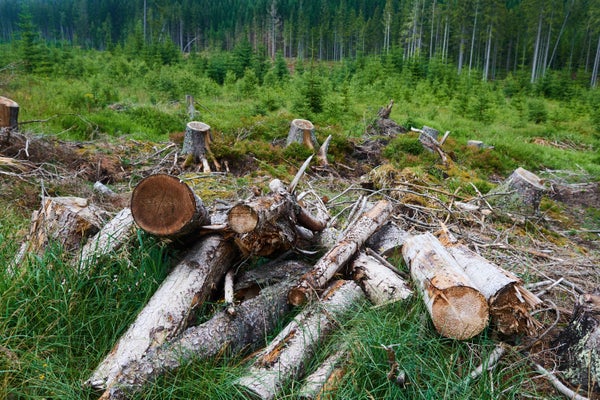
A tiny, creeping menace is threatening forests across Europe. And scientists believe climate change is a big part of the problem.
New research finds that European forests have become more vulnerable to insect pest outbreaks over the last four decades, and especially since the year 2000.
The study used a combination of on-site observations, satellite data and models based on machine-learning technology to investigate the way European forests are responding to climate-related disturbances. They focused on three major threats: wildfires, insect outbreaks and "windthrows," or strong winds that can rip up trees by the roots.
On supporting science journalism
If you're enjoying this article, consider supporting our award-winning journalism by subscribing. By purchasing a subscription you are helping to ensure the future of impactful stories about the discoveries and ideas shaping our world today.
Led by Giovanni Forzieri, a scientist with the European Commission's Joint Research Centre, the researchers looked at data stretching back to 1979. They tracked the amount of biomass lost following each disturbance.
Overall, the study finds that nearly 60% of Europe's forests may be vulnerable to insects, wildfires and windthrows.
In general, wildfires tend to kill off the most trees, followed by windthrows and finally insect outbreaks. But the response to wildfires and windthrows hasn't changed much over the last few decades, while forests have become more vulnerable to insects over time.
The research also shows that wildfires and windthrows have a greater impact in some places than in others. Wildfires are more damaging in drier places where water stress is a growing problem, such as Italy and southern France. Windthrows are more damaging in the Balkans, where a combination of increasing precipitation and stronger winds may make it easier to topple trees.
Insect outbreaks, on the other hand, are causing more damage almost everywhere across the continent.
Rising temperatures are a likely culprit, the researchers theorize. The study doesn't prove there's a link — but the scientists note that higher heat can cause plants to lose water faster, making them less resilient to environmental disturbances. This extra stress may make it harder for trees to bounce back when an outbreak occurs.
Other studies have found that water stress is an important factor in the severity of bark beetle outbreaks.
The biggest changes have happened since the year 2000, the study finds. The researchers describe it as a kind of "tipping point" — a threshold, possibly linked to continental warming, beyond which forests became significantly less resilient to pests.
The new study doesn't actually investigate whether insect outbreaks are happening more frequently — it just looks at how badly forests have been responding to them over time. But recently scientists have raised red flags about insect outbreaks.
Bark beetles pose some of the biggest problems.
While there are thousands of species of bark beetles all over the world, many of them share a common life cycle. They burrow into the trunks of trees, feed on the fresh wood and lay eggs beneath the bark. In large enough numbers, they can be devastating even to healthy forests — but they're especially harmful to trees that are already sick or stressed.
Bark beetle outbreaks have wreaked havoc recently across swaths of Europe.
The Czech Republic is among the countries hardest hit. According to Reuters, bark beetles infested around 18 million cubic meters of timber there in 2018 — around 10 times the amount typically seen in previous years.
In 2019, Reuters reported, that number nearly doubled to around 30 million cubic meters, costing Czech forest owners around $1.7 billion in damages.
Reprinted from E&E News with permission from POLITICO, LLC. Copyright 2021. E&E News provides essential news for energy and environment professionals.