How to Map an Exoplanet's Rings

Dips in starlight reveal the architecture of a super Saturn around a distant star

Join Our Community of Science Lovers!


On supporting science journalism

If you're enjoying this article, consider supporting our award-winning journalism by subscribing. By purchasing a subscription you are helping to ensure the future of impactful stories about the discoveries and ideas shaping our world today.


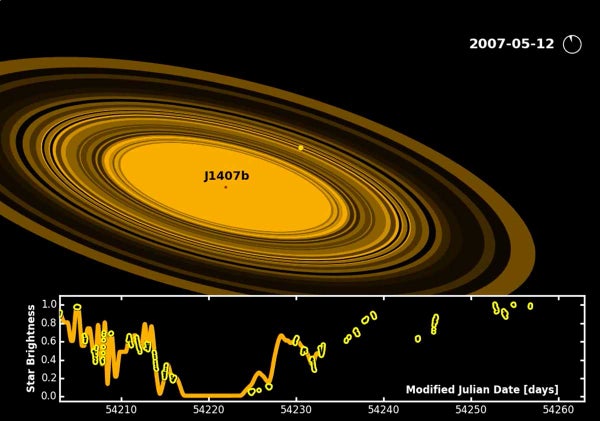
In “Astronomers Make a Map of a Super Saturn's Rings,” from the January issue of Scientific American, the Leiden University astronomer Matthew Kenworthy tells the story of discovering a ring system some 200 times larger than Saturn’s around the distant star J1407. Despite its rather large size, across interstellar distances this ring system would normally be totally invisible to us—and in fact Kenworthy and his peers have yet to glimpse J1407b, the giant planet that must be its host. The only reason we know the ring system exists at all is that, by chance, Kenworthy and other researchers happened to see its shadow after it “transited” across the face of its star in 2007.

Kenworthy’s video animation below maps a model of J1407’s rings onto actual data (yellow-bordered dots) from that transit. Each ring blocks a small amount of starlight, casting a shadow that we can detect here on Earth. By stringing together the successive dips in starlight and studying how quickly each one occurred, Kenworthy and his colleagues were able to infer that the system contains at least a hundred rings, and that it is tilted at an angle respective to our perspective on Earth. Intriguingly, they also spied a large empty region in the system, a telltale sign of what might be a Mars-sized moon—an exomoon—sweeping out a gap as it moves through the rings.

No further transits have occurred since 2007—the unseen planet J1407b and its rings have yet to complete another orbit around their star. Kenworthy and several other astronomers are now monitoring J1407 almost every night, awaiting the first fateful dip in starlight from the onset of the next transit. If and when it occurs, a worldwide observation campaign will seek to confirm its architecture and its exomoon, while also mapping it in even more detail.

Lee Billings is a science journalist specializing in astronomy, physics, planetary science, and spaceflight and is senior desk editor for physical science at Scientific American. He is author of a critically acclaimed book, Five Billion Years of Solitude: The Search for Life Among the Stars, which in 2014 won a Science Communication Award from the American Institute of Physics. In addition to his work for Scientific American, Billings’s writing has appeared in the New York Times, the Wall Street Journal, the Boston Globe, Wired, New Scientist, Popular Science and many other publications. Billings joined Scientific American in 2014 and previously worked as a staff editor at SEED magazine. He holds a B.A. in journalism from the University of Minnesota.

More by Lee Billings
Scientific American Magazine Vol 314 Issue 1This article was published with the title “How to Map an Exoplanet's Rings” in Scientific American Magazine Vol. 314 No. 1 ()
doi:10.1038/scientificamerican012016-5fMyZZ0i8OumGTcZKYuRfm

It’s Time to Stand Up for Science

If you enjoyed this article, I’d like to ask for your support. Scientific American has served as an advocate for science and industry for 180 years, and right now may be the most critical moment in that two-century history.

I’ve been a Scientific American subscriber since I was 12 years old, and it helped shape the way I look at the world. SciAm always educates and delights me, and inspires a sense of awe for our vast, beautiful universe. I hope it does that for you, too.

If you subscribe to Scientific American, you help ensure that our coverage is centered on meaningful research and discovery; that we have the resources to report on the decisions that threaten labs across the U.S.; and that we support both budding and working scientists at a time when the value of science itself too often goes unrecognized.

In return, you get essential news, captivating podcasts, brilliant infographics, can't-miss newsletters, must-watch videos, challenging games, and the science world's best writing and reporting. You can even gift someone a subscription.

There has never been a more important time for us to stand up and show why science matters. I hope you’ll support us in that mission.

Thank you,

David M. Ewalt, Editor in Chief, Scientific American

Subscribe