
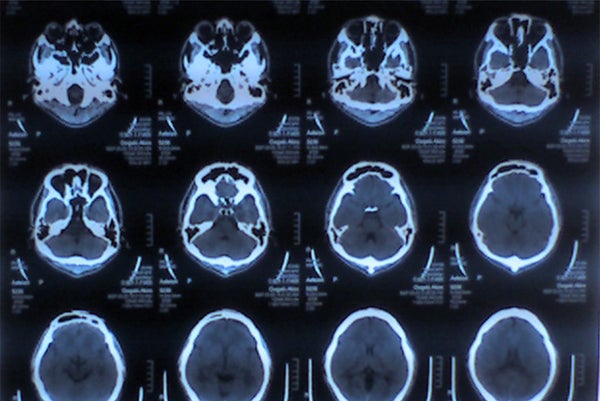
Glioblastoma is one of the deadliest cancers — an illness that responds to few treatment options, and often poorly. But a single case study that uses an experimental immunotherapy to treat these brain tumors might give oncologists a new way to approach the disease.
The therapy, called CAR-T, is controversial and has faced hurdles in clinical trials. It has shown great promise in treating blood cancers like leukemia and lymphoma — but has proven challenging in treating other forms of the disease, including solid tumors.
“This is the first example of CAR-T working in solid tumor cancers,” said Dr. Behnam Badie, chief of neurosurgery at City of Hope and a key investigator in the study. “In the initial treatments, I was holding my breath, waiting to get called in the middle of the night to go rescue somebody. But it’s amazing how safe it was.”
On supporting science journalism
If you're enjoying this article, consider supporting our award-winning journalism by subscribing. By purchasing a subscription you are helping to ensure the future of impactful stories about the discoveries and ideas shaping our world today.
The results are being published this week in the New England Journal of Medicine.
Researchers at the City of Hope cancer treatment center in the Los Angeles Area tested a CAR-T therapy out on a 50-year-old man with recurrent multifocal glioblastoma — that is, several tumors growing in tandem in his brain. He had failed all other available treatments.
CAR-T therapy involves extracting a patient’s immune cells, re-engineering them to learn how to target their cancer, and then feeding them back into the body. Surgeons removed the tumors, and then infused the experimental cellular therapy directly to the regions where the cancer had grown (other CAR-T treatment protocols are usually intravenous).
The patient was in remission for about seven months after the CAR-T infusions began. The tumors did come back — but not in the areas that responded to the T cells, Badie said.
This experimental therapy may soon be available commercially for certain blood cancers, as two drug makers — Novartis and Kite Pharma — are on the verge of filing for approval with the Food and Drug Administration.
The glioblastoma therapy targets cells with the IL-13Rα2 antigen, a receptor which is found commonly on cells in brain tumors. City of Hope researchers are testing out a number of other antigens specific to brain cancers, Badie said, though they’re not disclosing which.
Notably, the treatment was fairly innocuous, Badie said, which was certainly unexpected, since CAR-T therapy is notorious for its adverse events. In particular, Badie said he was bracing himself for neurotoxicity:
“The results were really dramatic,” Badie said. “My own father passed from glioblastoma 10 years ago — and I never imagined we’d get to this stage so fast.”
There have been other trials studying CAR-T’s efficacy in glioblastoma, but with intravenous application. The results from this one patient, Badie said, were good initial evidence that delivering CAR-T to the tumor site itself, rather than intravenously, might enhance efficacy. Badie said he believes that, based on this study, CAR-T could prove to be potent in other solid tumor cancers — particularly pediatric brain cancers.
The results spurred both cautious optimism — and a dose of skepticism.
“I can’t say this paper’s solved the problem of solid tumors, or this is the way to treat them,” said Dr. Jae Park, a hematologist-oncologist who specializes in CAR-T therapy at Memorial Sloan Kettering Cancer Center. “But it’s the first trial to show an objective response in glioblastoma, and suggests this is one way to get around the limitations of CAR-T.”
But it’s a “flash in the pan,” according to Dr. Vinay Prasad, a hematologist-oncologist at the Oregon Health and Sciences University.
“Even though this was a provocative case, even in this one case the cancer has already returned,” Prasad said in an email. “Will CAR-T work for other patients? Will it help most patients? Will it be better than alternatives? And will patients live longer or live better? We don’t know.”
Republished with permission from STAT. This article originally appeared on December 28, 2016