
Can we test the claims of theology with experiments? In science, theories are routinely subjected to the guillotine of experiments. The same could apply to any theory that puts “skin in the game” and makes testable predictions, even if those are in the realm of theology. This was already recognized by Isaac Newton, as discussed in Michael Strevens’ new book The Knowledge Machine. “I feign no hypotheses,” wrote Newton in 1713 for the second edition of his book Principia.
Recently, in the course of my routine duties at Harvard University I had no choice but to echo Newton’s viewpoint. During a Ph.D. exam, a committee member asked a student: “Do you know why Giordano Bruno was burnt at the stake?” After pausing for a while, the student replied hesitantly: “Because he had a blunt personality and was disliked by many people.” The examiner stated forcefully: “No! It was because Bruno proposed that stars were distant suns surrounded by planets which might foster life. And if extraterrestrials sinned, then multiple Christs should have appeared on these exoplanets to save them, a possibility resented by the Church.” Indeed, this is the latest interpretation of Bruno's heresy. In an attempt to add a scientific tone to the discussion, I noted that astronomers now know that a major fraction of all sunlike stars host habitable Earth-size planets. We can therefore test this theology by asking extraterrestrial civilizations that had sinned whether they witnessed Christ.
The idea of testing theology is not new. According to an apocryphal story told by Nobel laureate Elie Wiesel, the philosopher Martin Buber noted that the biggest dispute between Christianity and Judaism stems from Christianity’s claim that the Messiah had arrived and will return, whereas Judaism maintains that the Messiah will come in the future for the first time. Why argue? asked Buber; since both sides agree that the Messiah will arrive in the future, let’s wait until that moment and then simply ask the Messiah: have you been here before?
On supporting science journalism
If you're enjoying this article, consider supporting our award-winning journalism by subscribing. By purchasing a subscription you are helping to ensure the future of impactful stories about the discoveries and ideas shaping our world today.
And here is a third example. My colleague Stephen Greenblatt recently wrote an insightful review about Maggie O’Farrell’s novel Hamnet. The review describes how Shakespeare’s dedication to his work in London may have prevented him from assisting his wife to save the life of his son, Hamnet, during the bubonic plague. In a conversation with Stephen, I noted the similarity to the biblical story of Abraham’s willingness to sacrifice the life of his son Isaac for a higher purpose, but Stephen argued correctly that Abraham’s action involved “the teleological suspension of the ethical,” as explained by the philosopher Søren Kierkegaard. “If you know that it is your imagination that is speaking to you, you are less likely to hold a knife against your son’s throat—though in Shakespeare’s case, his imagination evidently spoke loudly enough to induce him to leave his family and move to London,” Stephen reasoned.
I concurred; there is no doubt that Abraham was convinced he heard the voice of God. With a modern recording device on a cell phone, he could have convinced all of humanity that God spoke to him. But since he did not own a voice memo app, we need to rely on testimonial evidence which does not stand up to the standards of scientific scrutiny.
Is there a theology that is undoubtedly consistent with the scientific method? Such a framework was, in fact, proposed by the philosopher Baruch Spinoza, who identified God with nature. As Albert Einstein noted, this definition of God is in line with modern science. But as in Bruno’s case, Spinoza’s ideas were denounced by the religious establishment.
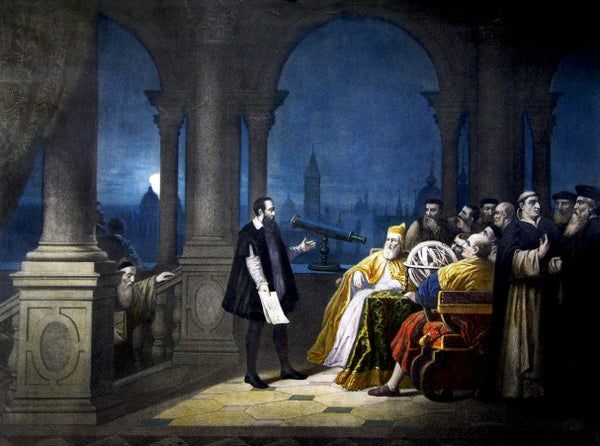
It is understandable why some people prefer not to test their beliefs, but evidence-based science teaches us that reality does not go away when you ignore it. The Earth continued to revolve around the sun even after philosophers refused to look through Galileo Galilei’s telescope and he was put in house arrest. Following that experience, one would naively expect physicists to pursue only theories that are guided by testable predictions. Unfortunately, that is not always the case—for example, when unfalsifiable ideas like “the existence of the multiverse” and “we live in a simulation” are celebrated by mainstream scientists. This trend receives moral justification from some philosophers who argue that empirical evidence should not be a prerequisite for theories in physics. Apparently, history repeats itself. Untestable ideas appeal to the human mind because they are unconstrained and could be more beautiful than reality, irrespective of whether we engage in theology or science.
Quoting Spinoza from his 17th-century book Ethics: “… these imaginations of the mind, regarded by themselves, contain no error.... For if the mind, when it imagines non-existent things to be present, could at the same time know that those things did not really exist, it would think its power of imagination to be a virtue of its nature and not a defect….”
Eliminating what Strevens attributes to Newton as an “iron rule” for evidence-based reasoning in science is equivalent to lifting the legal prohibition on hallucinogens. Only actual evidence can improve our perception of reality. For more on this theme, check my new book Extraterrestrial.