
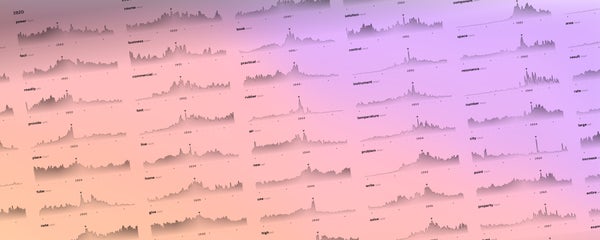
We invite you to dive in and explore a database of words that appeared prominently in the print history of Scientific American. Below, each year of that historyis represented by a single word, which was selected through a text-analysis project that started with all 5,107 issues of the magazine. Words whose relative frequency peaked in each individual year were identified. Among those top contenders, the single noun, verb, adjective or adverb that was used most often was deemed the winner. The line charts, which reflect the frequency of each word over time from 1845 (far left) to 2020 (far right), are scaled to the maximum value. To learn more about how the data were collected, analyzed and visualized, see “How to Turn 175 Years of Words in Scientific American into an Image.”
As science historian Lorraine Daston wrote in an essay for our special 175th anniversary issue: “Science has never been speechless. Scientific journals began in the 17th century, and since then, science has been all about communication—first and foremost between scientists and other scientists, but also with a broader public fascinated by the latest discoveries, inventions and speculations about fossils, electricity, atoms, computers, genes and galaxies.... It is entirely in keeping with the visual spirit of scientific communication that the very words used in all 5,107 issues of Scientific American since 1845 should be turned into an image. [In this project, you’ll see] word frequencies undulate, soaring and plunging as a function of time to track the way science talked about itself to itself.”
To read more from Daston—and for a guided graphical tour of popular words paired with key moments in the history of the magazine—see “Visualizing 175 Years of Words in Scientific American.”
Have you found fun patterns or interesting word juxtapositions? Share your screenshots and thoughts on social media using the hashtags #SciAm175 and #ScienceWords.