
On January 31, 1958, the U.S. put its first satellite into space. As the Jupiter C rocket carrying the satellite burned its way through the upper atmosphere, engineers at Cape Canaveral in Florida were “shouting, singing, cheering.” At the National Academy of Sciences, there was “hardly elbow room among the crowd on hand to hear that the first U.S. satellite, Explorer 1, was up.”
But how did Americans feel about what followed? Many people think that NASA's programs of the late 1950s and 1960s were extremely popular, and it is often said that the Apollo program unified an otherwise disunified nation. In our current moment of national disunity, it is tempting to imagine a reinvigorated program of space exploration bringing us back together.
Sadly, however, space exploration has never been the national unifier that many people think. While scientists cheered Explorer 1, a good many would oppose the human spaceflight programs that followed, viewing them as expensive, dangerous and largely symbolic. Many military leaders also opposed human spaceflight, preferring to see resources focused on the crucial challenges of rocket propulsion and guidance, essential for the emerging intercontinental ballistic missile (ICBM) program.
On supporting science journalism
If you're enjoying this article, consider supporting our award-winning journalism by subscribing. By purchasing a subscription you are helping to ensure the future of impactful stories about the discoveries and ideas shaping our world today.
Dwight Eisenhower, president at the time of Explorer 1, was a reluctant space warrior, rejecting the idea of a space race since “race” implied haste, which would likely lead to waste. Moreover, while it was often asserted that space superiority would translate into military superiority, Ike believed that the U.S. could be fully defended with existing nuclear weapons and conventional forces. In later years he would dismiss the Apollo program as a “stunt.”
And then there was the cost. Under Presidents John F. Kennedy and Lyndon B. Johnson, NASA's budget skyrocketed—Apollo would be the largest peacetime expenditure in American history—and Congress got increasingly uneasy. NASA's 1964 budget was $5.1 billion; the 1965 budget was $5.3 billion. For Democrats wanting to expand spending on social problems and Republicans wanting to shrink the federal budget, these were disturbing numbers.
They disturbed the American people, too. Throughout the 1960s polls showed that a majority of Americans did not believe the Apollo program was worth the cost. But after Americans made it to the moon, most of the earlier skepticism was forgotten, and as Apollo receded into history people had an increasingly favorable view of it. According to one poll, in 1989, 77 percent of Americans thought the moon landing was worth the cost, in contrast to 1979, when only 47 percent felt that way. Perhaps it is the idea of space that unifies us, particularly when burnished by the glow of nostalgia. Or perhaps it is simply that nothing succeeds like success: after the lunar landing, Americans decided that it had been worth the price after all.
NASA now plans to go again to the moon, with a goal of landing astronauts—among them at least one woman—near the lunar south pole in 2024, and once again the American people, including many scientists, are skeptical of the value. Most Americans are pro-NASA and pro-space. A 2018 Pew Research poll found that 80 percent think the space station has been a good investment, 72 percent think it is essential for the U.S. to remain a global leader in space, and 65 percent say that should happen through NASA, not primarily through private companies. But only 18 percent think it should be a top priority to send humans to Mars, and only 13 percent support sending humans to the moon.
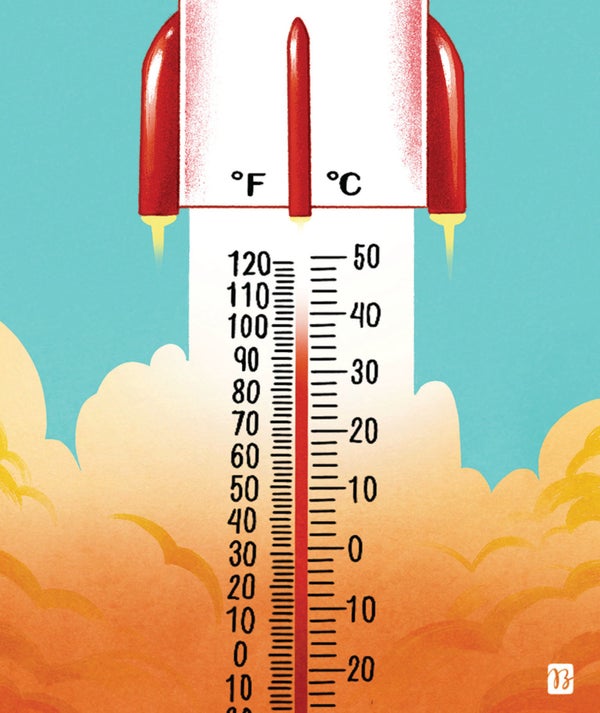
So what do Americans want NASA to do? The answer may come as a surprise: 63 percent say NASA should make monitoring global climate a top priority. If we include those who think it should be an important (but not top) priority, the percentage increases to a whopping 88 percent. The second-highest priority is looking for asteroids or other objects that might hit our planet. Many of us have been loath even to talk about climate change because it is seen as divisive—but one thing that seems to unify us is the belief that the most important thing we can do in space is to collect information to protect ourselves and our one and only Earth.