
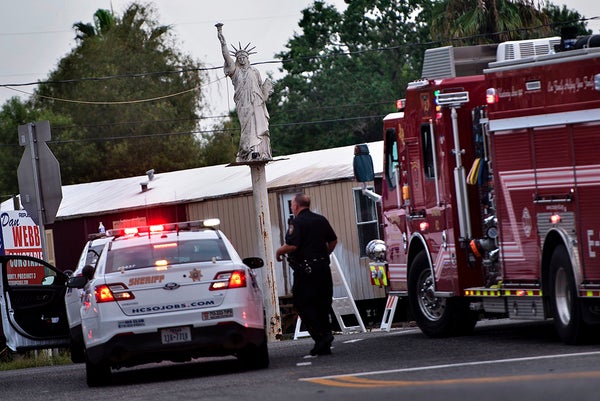
WASHINGTON/AUSTIN, Texas (Reuters) - Two explosions hit the flood-swamped Arkema SA (AKE.PA) chemical plant 25 miles northeast of Houston early on Thursday, and a sheriff’s deputy was taken to a hospital after inhaling fumes, the French company said.
Arkema said further explosions of organic peroxides produced by the Crosby, Texas, plant and stored onsite were possible, and it urged people to stay away as the fire burns itself out. Black smoke was billowing from the site, Harris County Sheriff Ed Gonzalez told reporters at a televised news briefing.
The Federal Aviation Administration said Wednesday it had temporarily barred flights from the area because of the risk of fire or explosion.
On supporting science journalism
If you're enjoying this article, consider supporting our award-winning journalism by subscribing. By purchasing a subscription you are helping to ensure the future of impactful stories about the discoveries and ideas shaping our world today.
Assistant Fire Chief Bob Rayall said on Thursday that “a series of pops” at the scene led to the fires. “We haven’t had massive explosions,” Rayall said, emphasizing the fires had been contained so far.
Rayall said three of the site’s nine containers with the peroxides had lost refrigeration, and one had caught fire.
Arkema said the company had no way to prevent fires because the plant is swamped by about 6 feet (1.83 m) of water due to flooding from Harvey, which came ashore in Texas last week as a powerful Category 4 hurricane, knocking out power to its cooling system.
The company said the Harris County Emergency Operations Center notified it at about 2 a.m. CDT of two explosions and black smoke coming from the plant in Crosby.
“Organic peroxides are extremely flammable and, as agreed with public officials, the best course of action is to let the fire burn itself out,” Arkema said.
The peroxides are used to make plastic resins, polystyrene, paints and other products.
The sheriff’s office said on Twitter that the deputy had been taken to hospital, and 14 others drove themselves there as a precaution. Eight have been released, and seven remain under observation.
The department said it believed the smoke was a “non-toxic irritant.”
“Remain well clear of the area and follow directions of local officials,” the National Weather Service said after the explosions, noting that winds were from the west to the east from 4 to 9 miles (6.4 to 14.5 km) per hour.
The plant had been closed since Friday, and the company had evacuated remaining workers on Tuesday. Harris County ordered the evacuation of several hundred residents within a 1.5-mile (2.4 km) radius.
“We want local residents to be aware that product is stored in multiple locations on the site, and a threat of additional explosion remains,” Arkema said. “Please do not return to the area within the evacuation zone.”
The company’s shares were down 1.9 percent in Paris trading.
Richard Rowe, chief executive officer of Arkema’s North America unit, told reporters on Wednesday that chemicals on the site would catch fire and explode if they were not properly cooled.
Arkema said it opted not to move chemicals before the storm but made extensive preparations. A company spokeswoman did not immediately say when Arkema believes the fires will end.
Rowe said a fire would not pose any “long-term harm or impact.”
The plant has been without electric service since Sunday. It lost refrigeration when backup generators were flooded, and workers transferred products from warehouses into diesel-powered refrigerated containers.
The company said some refrigeration of back-up containers has been compromised because of high water levels and that it was monitoring temperature levels remotely.