
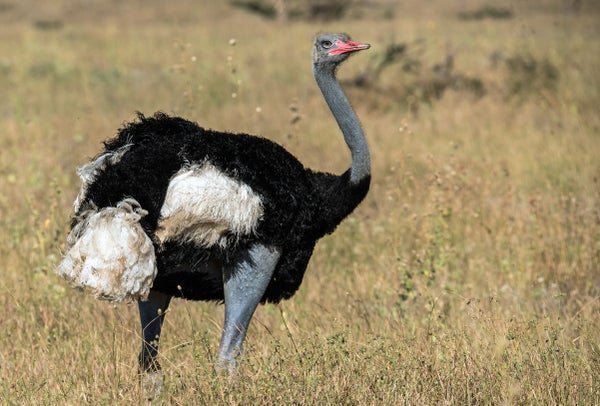
Near the dawn of the last ice age, an enormous terrestrial bird about three times the size of a modern ostrich jogged across eastern Europe, according to a fossil femur recently found in Crimea.
Analysis of the femur revealed that it belonged to a brawny bird that lived about 2 million years ago; scientists dubbed it Pachystruthio dmanisensis.
In life, the bird stood 11 feet (3 meters) tall and weighed more than 990 pounds (450 kilograms) — almost as much as a polar bear — making it one of the heaviest-known birds of all time, the researchers reported in a new study. [15 of the Largest Animals of Their Kind on Earth]
On supporting science journalism
If you're enjoying this article, consider supporting our award-winning journalism by subscribing. By purchasing a subscription you are helping to ensure the future of impactful stories about the discoveries and ideas shaping our world today.
Massive avians such as this were already known from Australia, New Zealand and Madagascar; prior to this study, fossils placed extinct ostrich-like birds in Georgia, Hungary, Russia, Turkey and Ukraine. However, this newfound femur is the first evidence that giant, flightless birds inhabited Europe during the Pleistocene epoch (2.6 million to 11,700 years ago), the study authors wrote.
"The lineage to which Pachystruthio belonged most probably first appeared in the Pliocene [2.6 million to 5.3 million years ago] of Turkey or adjacent regions," lead study author Nikita Zelenkov, a paleontologist with the Russian Academy of Sciences, told Live Science in an email.
Large and in Charge
Scientists excavated the femur in the Taurida cave network on the Crimean Peninsula; the caves were discovered in 2018 during excavation for a new highway, Zelenkov said. Though the bone resembles an ostrich femur, it is significantly more robust. Measurements of the bone's shaft circumference enabled the scientists to calculate the great bird's weight, he told Live Science.
Unlike large extinct birds that were island dwellers, Pachystruthio shared its habitat in Crimea with a number of large carnivorous mammals, such as saber-toothed cats in the genuses Homotherium and Megantereon, giant hyenas (Pachycrocuta brevirostris) and giant cheetahs (Actionyx pardinensis). The bird was so big that it probably couldn't run very fast, but its impressive heft likely discouraged smaller predators from attacking, the scientists wrote.
Bigger animals are also capable of surviving on low-nutrition, tough foods; one possible explanation for Pachystruthio's extreme size is that it evolved to take advantage of a landscape that was growing increasingly arid due to a changing climate, as the glacial period took hold across eastern Europe.
Millions of years ago, the region around the Taurida cave system hosted diverse Pleistocene beasts; fossils that were previously found in the area represented animals such as horses, bison, dogs, camels, rhinos and deer, according to the study. Now that scientists know these giant birds were part of this ice-age ecosystem, they can begin to piece together how the birds may have interacted with other animals — and with early humanswho may have hunted them.
"There may be much more that the site will teach us about Europe's distant past," Zelenkov said in a statement.
The findings were published online yesterday (June 26) in the Journal of Vertebrate Paleontology.
Copyright 2019 LIVESCIENCE.com, a Future company. All rights reserved. This material may not be published, broadcast, rewritten or redistributed.