Extreme Light

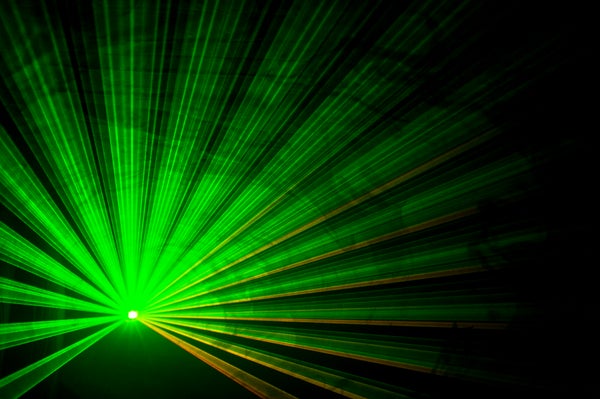
Tabletop lasers focus light with the power of 1,000 Hoover Dams onto a tiny point for applications from physics and fusion research to medicine

Join Our Community of Science Lovers!

The dream of intensifying light is as old as civilization. Legend has it that Archimedes focused the sun’s rays with a giant mirror to set the Roman fleet afire at Syracuse in 212 B.C. Although that story is a myth, it is true that around 200 B.C. another Greek, Diocles, had invented the first ideal focusing optic, a parabolic mirror. Two millennia later mirrors and quantum mechanics were put together to make the most versatile of high-intensity light sources: the laser.

The epitome of high-power lasers is Nova, which operated at Lawrence Livermore National Laboratory from 1985 to 1999. Named for the brilliance of an exploding star, Nova was one of the largest lasers ever built. Ten parallel chains of laser amplifiers occupied a 300-foot enclosure; mirrors made from 400-pound blocks of glass directed the beams to targets for nuclear fusion and other experiments. Nova was fired no more than a few times each day to avoid overheating. Clearly, it marshaled a lot of energy to achieve its ultrahigh power.

Yet power is the rate at which energy is delivered, so another approach to ultrahigh power is to release a modest amount of energy in an extremely short time. Nova’s usual pulses were relatively long by the standards of today’s ultrafast lasers—three nanoseconds—and each one required kilojoules of energy. By using pulses of one ten-thousandth their durations, a new type of laser that fits on a tabletop can deliver power similar to Nova’s [see “Ultrashort-Pulse Lasers: Big Payoffs in a Flash,” by John-Mark Hopkins and Wilson Sibbett; Scientific American, September 2000]. For example, an ultrahigh-power laser that delivers a mere joule in a pulse lasting 100 femtoseconds (10–13 second) achieves 10 trillion watts (1013 W, or 10 terawatts), more than the output of all the world’s power plants combined.


On supporting science journalism

If you're enjoying this article, consider supporting our award-winning journalism by subscribing. By purchasing a subscription you are helping to ensure the future of impactful stories about the discoveries and ideas shaping our world today.


To continue reading this article, please download the PDF below.

Download PDF

GÉRARD A. MOUROU and DONALD UMSTADTER were among the founders of the National Science Foundation–sponsored Center for Ultrafast Optical Science at the University of Michigan at Ann Arbor. Mourou, the director of the center, is a professor of electrical engineering, and Umstadter is an associate professor of both nuclear and electrical engineering. When they are not accelerating particles with intense lasers, they can be found accelerating down ski slopes to "ultrahigh" speeds.

More by Gérard A. Mourou and Donald Umstadter
Scientific American Magazine Vol 286 Issue 5This article was published with the title “Extreme Light” in Scientific American Magazine Vol. 286 No. 5 ()
doi:10.1038/scientificamerican052002-43G6luVddFO7LZ9bocWQTO

It’s Time to Stand Up for Science

If you enjoyed this article, I’d like to ask for your support. Scientific American has served as an advocate for science and industry for 180 years, and right now may be the most critical moment in that two-century history.

I’ve been a Scientific American subscriber since I was 12 years old, and it helped shape the way I look at the world. SciAm always educates and delights me, and inspires a sense of awe for our vast, beautiful universe. I hope it does that for you, too.

If you subscribe to Scientific American, you help ensure that our coverage is centered on meaningful research and discovery; that we have the resources to report on the decisions that threaten labs across the U.S.; and that we support both budding and working scientists at a time when the value of science itself too often goes unrecognized.

In return, you get essential news, captivating podcasts, brilliant infographics, can't-miss newsletters, must-watch videos, challenging games, and the science world's best writing and reporting. You can even gift someone a subscription.

There has never been a more important time for us to stand up and show why science matters. I hope you’ll support us in that mission.

Thank you,

David M. Ewalt, Editor in Chief, Scientific American

Subscribe