
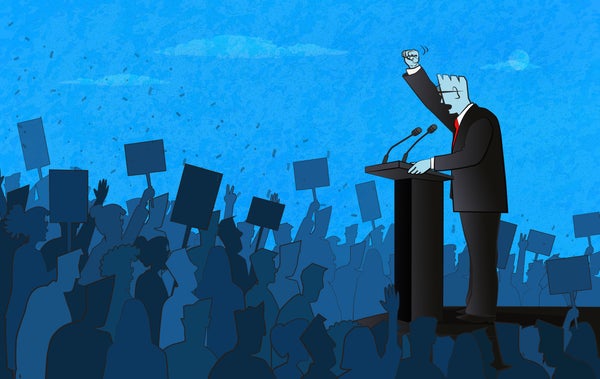
Do you ever feel like everyone on social media has a more extreme viewpoint than your own? We often blame social media companies for the cacophony of politically extreme opinions around us. After all, these companies are generally motivated to promote the most emotionally potent and attention-grabbing content and perspectives.
But my colleagues and I have conducted research that suggests these platforms’ users share some of the responsibility. In several studies, we found that people prefer connecting with others who are, on average, more politically extreme than themselves.
[Read more about how social media influencers increase political polarization]
On supporting science journalism
If you're enjoying this article, consider supporting our award-winning journalism by subscribing. By purchasing a subscription you are helping to ensure the future of impactful stories about the discoveries and ideas shaping our world today.
Until recently, researchers believed that the main principle involved in how we select our social ties has been what the ancient Greeks called homophily, or love of the similar. Political homophily—love of those who are politically similar—is one of the strongest and best-documented phenomena in social science. It influences how we choose the city we live in, our schools, our partners, our hobbies and even our music.
Political homophily in the U.S. is common and increasing in intensity. In 1960 4 percent of Democrats and 5 percent of Republicans reported that they would be upset if their child married someone from the other party. By 2010 these numbers had grown to 33 percent of Democrats and 49 percent of Republicans. Homophily leads to political segregation, which in turn intensifies hostility and polarization.
But homophily is not the only driver of this segregation. In our research, we found that people are not only attracted by those who are politically similar but also attracted by those who hold more politically extreme versions of their views. This tendency is called acrophily, or love of extremes.
In a series of studies, we asked more than 1,200 people to rate their responses to diverse political situations. For example, participants reported their emotions upon seeing pictures of police brutality and expressed their views on topics such as gun control, hunting and increasing military spending. In between each prompt, we asked participants for their emotional response. Then we showed them the responses of six “peers.” These responses came from a pool of separate participants with varied political views who had weighed in on these topics and images in an earlier pilot study. We then asked participants to choose the peers whose viewpoints they would like to see in subsequent rounds of the experiment. Results suggested that people generally prefer to read about the emotional responses of those with similar views (political homophily) and are attracted to extremes (political acrophily). Whether liberal or conservative, participants tended to choose peers whose views were more extreme than their own.
Many factors may drive attraction to extremity. Individuals who hold zealous or intensely felt views may provide us with sharper arguments for the next online political discussion or Thanksgiving dinner debate. In addition, people who are more extreme may be more vocal and seem more coherent—that is, they have opinions across a range of issues that are more consistently aligned with a single political ideology. Those traits can be attractive. In research published last year, Argentine social scientist Federico Zimmerman and his colleagues asked 2,632 people to have a political discussion with a stranger and then rate how much they liked that person. Participants showed a strong preference for conversation partners who expressed more confident and ideologically consistent political views as opposed to those who had more ambiguous or ambivalent attitudes.
We have found an additional pattern that could help explain political acrophily. In one of our studies, we asked people to identify the viewpoints that they believed were most typical of their political group. The participants with a greater tendency to prefer extreme social ties also tended to think that the typical member of their political group was much more extreme than themselves. These participants may be attracted to extremes because they believe those intense viewpoints are more representative of their political group overall.
These findings suggest that correcting people’s biased impressions about their own political leanings might help reduce acrophily. In the big picture, we know that the most extreme members of a given group are unlikely to reflect the “average” perspective within that community. Yet some people in our study genuinely believed that to be the case. Helping people make more accurate evaluations of their group could therefore reduce acrophily and inform how individuals shape their views. If we are exposed to less extreme views in our social environment, our ideas may also become less extreme, which could reduce further political segregation and polarization.
Many questions remain to be answered about the power of acrophily. For example, our study hints that people may be seeking out and selecting more extreme voices on social media, as well as traditional media. But we do not know if these tendencies also influence friendship, marriage or other social connections. It’s one thing to enjoy reading an extreme perspective and another to interact regularly with someone who holds such views.
Yet our findings make it clear that further study is urgent. Using our data, we have developed models to simulate how people’s preferences for similar and extreme perspectives might lead to new social ties. We found that the combination of acrophily and homophily likely leads people to rapidly self-select into more extreme camps. Ultimately, that pattern speeds up segregation and makes it harder to cooperate, compromise and find common ground—all essential features of a healthy society.
Are you a scientist who specializes in neuroscience, cognitive science or psychology? And have you read a recent peer-reviewed paper that you would like to write about for Mind Matters? Please send suggestions to Scientific American’s Mind Matters editor Daisy Yuhas at pitchmindmatters@gmail.com.