
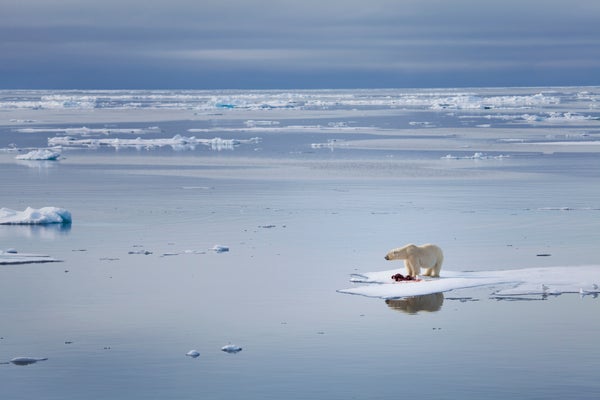
Despite a growing body of evidence that climate change is wreaking havoc on our environment and psyches, many people still resist making small lifestyle changes that may help mitigate disaster. The logic of climate science has not shaken enough people from their apparent complacency; neither has fear. So what will? Washington State–based thanatologist Kriss Kevorkian—a specialist in death, dying and bereavement—suggests that real motivation depends on people acknowledging their “environmental grief,” a term she coined after studying the decline of killer whale populations.
Grief over loss of human life is assigned a series of stages but Kevorkian (no relation to famed assisted-suicide doctor Jack Kevorkian) notes that we lack an analogous lexicon for the loss of our natural world and its creatures. Yet what else can we call the wrenching feeling of witnessing whales beaching themselves like toppled towers, bee populations dying off, even the death of a gorilla at a zoo?
This “is the grief reaction stemming from the environmental loss of ecosystems by natural and man-made events,” Kevorkian says. This theory builds on gerontologist Ken Doka’s work on “disenfranchised grief,” which is grief that is often unacknowledged or invalidated (often resulting from cases of suicide or abortion). Whereas the term “environmental grief” may be new, similar concepts emerged from “ecopsychology” and movements including the deep ecology of the 1970s, which drew from indigenous traditions to promote living in connection with nature.
On supporting science journalism
If you're enjoying this article, consider supporting our award-winning journalism by subscribing. By purchasing a subscription you are helping to ensure the future of impactful stories about the discoveries and ideas shaping our world today.
Kevorkian says that when the death of whales began causing her to experience grief as profound as it would be for members of her own family, she was hesitant to share this with others at first—until she found like-minded grievers. Now, at this critical climate juncture, she hopes to bring legitimacy to these experiences, much as naturalist Richard Louv made people aware of nature deficit disorder a decade ago.
She is not alone in her concern. A 2012 National Wildlife Federation (NWF) report (pdf) on the psychological effects of climate change estimates that 200 million Americans will be exposed to serious psychological distress from climate-related events and incidents. “Some Americans already are or will soon experience anxiety about global warming and its effects on us, our loved ones, our ecosystems and our lifestyles,” it reads. “This anxiety will increase as reports of the gravity of our condition become more clear and stark.”
The report makes a case for increased attention to this issue, and suggests those hardest hit by environmental grief would be the natural scientists and conservationists at the front lines. “A coral reef bleached or covered in sediment could make the person who simply hears about it sad, while the scientist who has studied that particular reef most of his or her career or the fisherman who relies on it for livelihood would be devastated,” the NWF report reads. John McIlwain, director of the Garrison Institute’s Climate, Mind and Behavior Program, describes the effects on natural scientists of ecological loss as “secondary trauma,” saying, “It takes a rare and brave human being to continue to do what needs to be done in the face of hopelessness.”
Samantha Whitcraft, a Florida-based conservation biologist and consultant scientist who has worked with National Geographic, WildAid and Shark Savers, says she persists in the face of such grief by taking small actions and celebrating “the little wins.” She says her grief reached a peak in 2013 when she went on an assignment in China with WildAid to make a survey of shark fins sold in local markets—and was “unprepared for the magnitude” of confronting the loss of so many other declining marine species. She recalls turning to the photographer who accompanied her and saying, “The irony of this moment is that you’re standing in the graveyard of the best dive of your life.” Her reward, though, was to “move the needle a little bit” and see a measurable decline in the sale of shark fins following her education efforts through WildAid and other organizations. “There’s a chain of productivity that potentially starts with recognizing what environmental and ecological grief is and recognizing it in yourself, and using that to move forward in ways that are healthy for us as individuals,” she says.
But not all experts agree that parsing terms to qualify one’s environmental grief will spur people to action. Chicago-based behavioral health therapist Rachel Kazez, who runs a mental health care consulting business, says that although some of her clients do express negative emotions about the environment, she worries about the perils of self-diagnosis. “If we ‘have’ environmental grief, then we might be less likely to act to change the environmental situation because it's just another external diagnosis,” she explains. “I think that we label and categorize things to legitimize them and in the process we pathologize the human experience.”
Kevorkian counters that she does not aim to pathologize anyone. “We need to galvanize our grief into action, to stop the ecocide taking place. We’re destroying our natural world of our wild cousins.” She concludes, “I keep going back to: Take baby steps that will help you keep moving forward. That's it. Just like Dory says in Finding Nemo, ‘Just keep swimming.’”