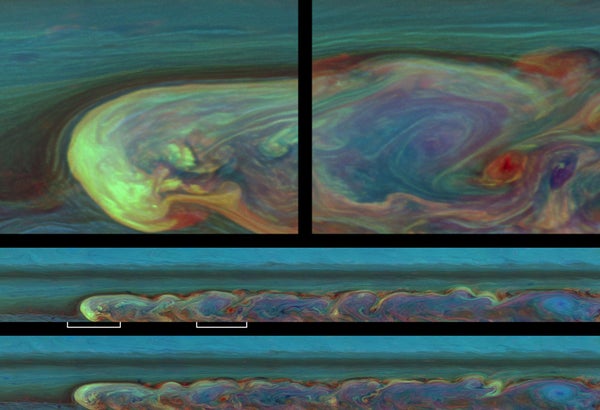
False Color Images of Saturn's Massive Lightning Storm

A raging storm on Saturn , larger and stronger than any previously observed by NASA's two Voyager flybys or the currently operating Cassini orbiter, has now been captured in new false-color image s.

NASA/JPL-Caltech/Space Science Institute

Join Our Community of Science Lovers!

A raging storm on Saturn, larger and stronger than any previously observed by NASA's two Voyager flybys or the currently operating Cassini orbiter, has now been captured in new false-color images. A mosaic of 84 pictures was taken by the latter probe's narrow-angle camera over a period of about five hours on February 26.

False, or representative, color helps scientists visualize data in wavelengths they cannot see. The colors used for Saturn's storm clouds represent different altitudes: blue indicates the highest, yellow and white are those at high altitudes, green shows intermediate layers, red and brown low altitude, and deep blue reveals a thin haze with no clouds below.

Lightning is generated at the base of the clouds. The storm generated more than 10 lightning flashes per second at its most intense, according to NASA. The still-active storm was first detected in early December and covers an area eight times the surface area of Earth.


On supporting science journalism

If you're enjoying this article, consider supporting our award-winning journalism by subscribing. By purchasing a subscription you are helping to ensure the future of impactful stories about the discoveries and ideas shaping our world today.


Cassini's imaging team leader Carolyn Porco wrote in a recent Captain's Log blog that recording "this major Saturnian event in detail [is] a space exploration first!"

—Ann Chin

It’s Time to Stand Up for Science

If you enjoyed this article, I’d like to ask for your support. Scientific American has served as an advocate for science and industry for 180 years, and right now may be the most critical moment in that two-century history.

I’ve been a Scientific American subscriber since I was 12 years old, and it helped shape the way I look at the world. SciAm always educates and delights me, and inspires a sense of awe for our vast, beautiful universe. I hope it does that for you, too.

If you subscribe to Scientific American, you help ensure that our coverage is centered on meaningful research and discovery; that we have the resources to report on the decisions that threaten labs across the U.S.; and that we support both budding and working scientists at a time when the value of science itself too often goes unrecognized.

In return, you get essential news, captivating podcasts, brilliant infographics, can't-miss newsletters, must-watch videos, challenging games, and the science world's best writing and reporting. You can even gift someone a subscription.

There has never been a more important time for us to stand up and show why science matters. I hope you’ll support us in that mission.

Thank you,

David M. Ewalt, Editor in Chief, Scientific American

Subscribe