
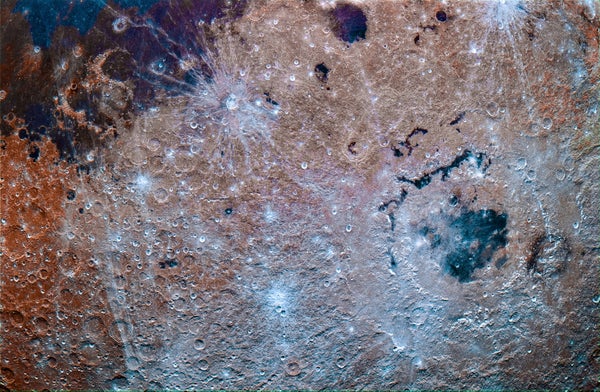
NASA astronaut and Artemis II mission commander Reid Wiseman and an astrophotographer have teamed up to create stunning, hypersaturated color images of the moon. The photographs reveal never-before-seen details of its surface.
When NASA’s Artemis II crew made their historic flyby around the farside of the moon in April, they saw from their capsule windows the gray and pocked lunar surface. One of the mission’s objectives was to capture ample photographic data, and throughout and after the spaceflight, NASA released unprecendented views of the moon. Now the image team at the space agency is still sorting through and processing the tens of thousands of images captured during the mission. Many of them are incredible, but they are all a bit gray.

The farside of the moon, color-enhanced to reveal minerals and impact craters.
Andrew McCarthy
On supporting science journalism
If you're enjoying this article, consider supporting our award-winning journalism by subscribing. By purchasing a subscription you are helping to ensure the future of impactful stories about the discoveries and ideas shaping our world today.
Thankfully, cosmic photographer Andrew McCarthy worked with mission commander Wiseman before the launch, teaching the astronaut how to get just the right kind of raw photographs on which he could work magic.
“I thought it would be a really cool opportunity to create photos that were maybe a little less scientific and a little more artistic,” McCarthy says.
McCarthy’s work had already drawn Wiseman’s attention on social media. And in the weeks leading up to the launch, the pair worked together to plan how to capture bursts of photographs from the moon’s far side, sometimes a hundred at a time. “I’m not really thinking in terms of reproducing what my eyes are seeing; I’m looking for hidden details; I’m looking for hidden colors,” McCarthy says.
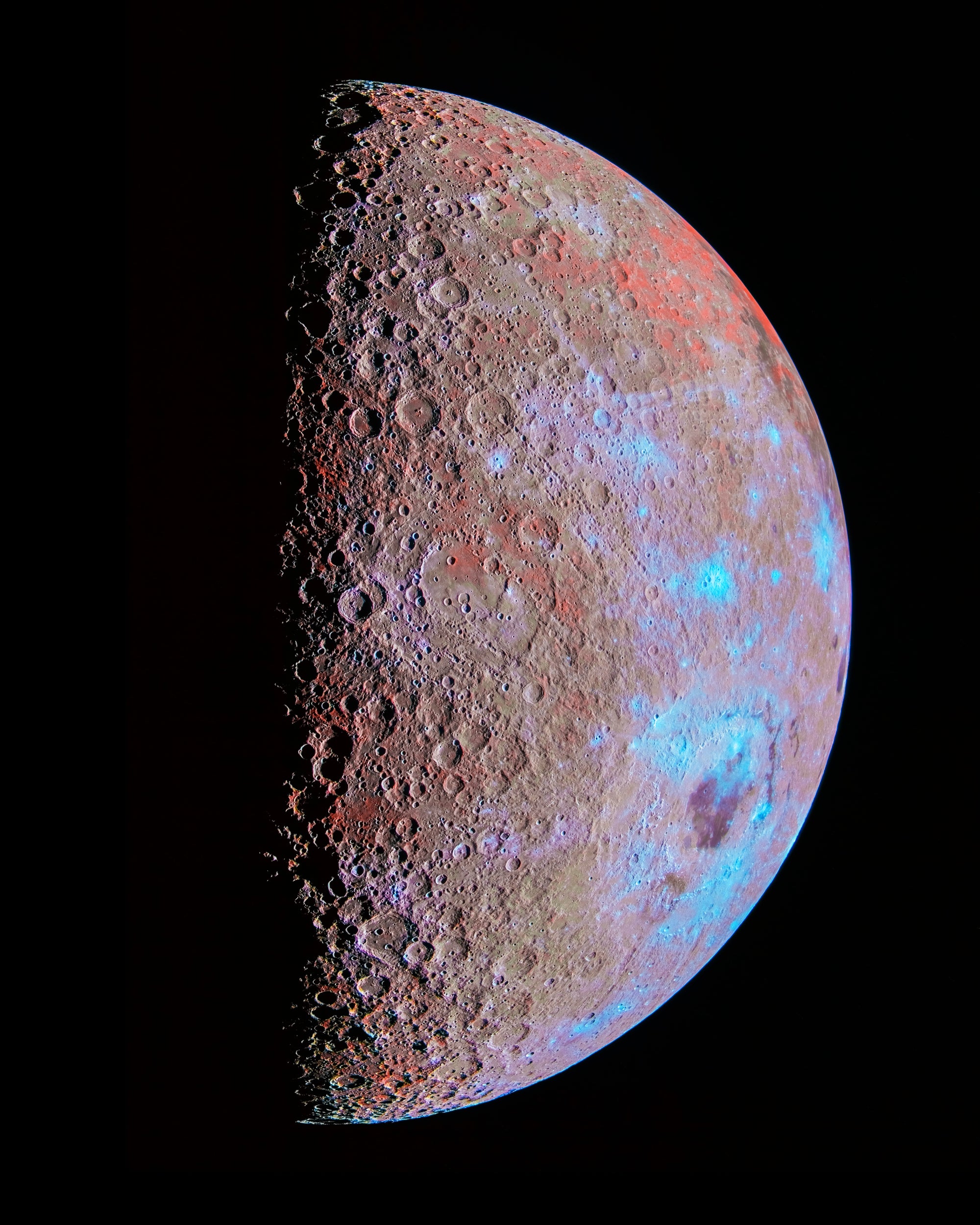
An image of the farside of the moon made up of about 100 photographs with the color enhanced to reveal meteorite craters and mineral composition.
Andrew McCarthy
McCarthy’s hypersaturated images are made by stacking together bursts of photographs taken by Wiseman on the farside of the moon and then balancing the colors and adjusting their relative saturations, which reveals subtle changes in terrain. And the results are downright jaw-dropping.
A photograph of a moving object (the moon) taken from a moving vantage point (the spacecraft) contains a lot of “noise,” meaning there are often many areas that are out of focus or places where details have been lost because the camera had moved in relation to its target. By stacking many photographs together and using computer software to filter out the noise, photographers can achieve a smoother, artifact-free version of the image.
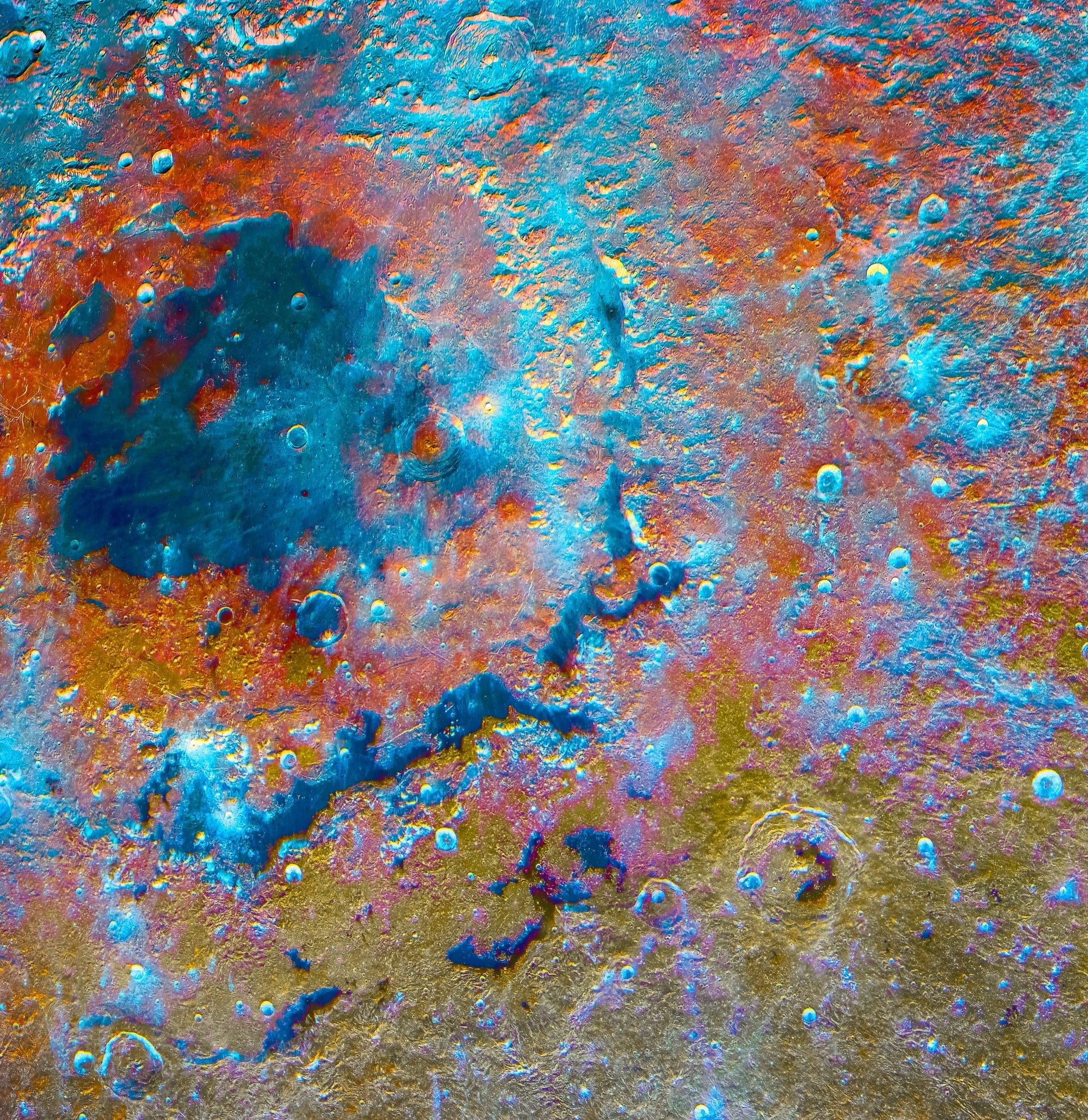
The lunar surface near Mare Orientale enhanced with hypersaturation of color, revealing minerals such as orange pockets of iron oxide.
Andrew McCarthy
This technique allows the photographer to isolate the color information captured in the image. Amping up the color saturation reveals more information about the moon’s topography: the red that emerges is most likely iron oxide, and blues are titanium-rich basalt, McCarthy says.
“I’m trying to bring those out in order to excite people and help them see our moon as more than just a dusty gray rock..., as the geological gold mine that it is,” he says.