
We are at a critical juncture in the fight to tackle the climate emergency. The world has just a few years to drastically rein in carbon emissions enough to avoid the worst impacts of warming, according to the concluding piece of the Sixth Assessment Report of the Intergovernmental Panel on Climate Change (IPCC), which was released on Monday. The report calls for countries to ramp up their pledges to lower greenhouse gas emissions enough to reduce global emissions by 60 percent by 2035.
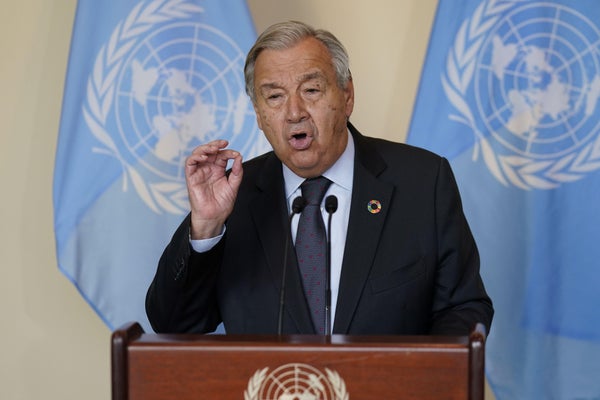
“The rate of temperature rise in the last half century is the highest in 2,000 years. Concentrations of carbon dioxide are at their highest in at least two million years. The climate time-bomb is ticking,” said United Nations secretary-general António Guterres in a video message played at a press conference about the report’s release. “But today’s IPCC report is a how-to guide to defuse the climate time-bomb. It is a survival guide for humanity.”
Every six to seven years the IPCC rounds up thousands of peer-reviewed studies with the latest findings in climate science to make conclusions regarding what is known about the causes of climate change, what its impacts will be, and how to mitigate and adapt to it. This last piece of the Sixth Assessment Report summarizes the science explained in detail in the previous installments, which were released over the past few years. It provides a jumping-off point for negotiators looking to implement the landmark Paris climate agreement. Under that treaty, nations have agreed to keep warming below two degrees Celsius by the end of the century and ideally to limit it below 1.5 degrees C.
On supporting science journalism
If you're enjoying this article, consider supporting our award-winning journalism by subscribing. By purchasing a subscription you are helping to ensure the future of impactful stories about the discoveries and ideas shaping our world today.
Among the findings of the overall report are that scientists “can show categorically that the earth has warmed by about 1.2 degrees [C] since preindustrial times” said Piers Forster, a climate scientist at the University of Leeds in England and an IPCC author, at a webinar hosted by the World Resources Institute (WRI) last week. That warming is “unequivocally” caused by human activities, primarily the burning of fossil fuels, the report states.
Likewise, climate scientists can clearly link those rising temperatures to more frequent and intense heat waves, floods, drought and other climate extremes. These extremes are contributing to biodiversity loss, increased tree mortality, more and worse wildfires and a loss of carbon from natural systems such as permafrost. “All these processes are already impacted by climate change,” said Jofre Carnicer, an ecologist at the University of Barcelona and an IPCC author, at the WRI event.
“These extremes will get worse as temperatures continue to rise,” Forster said at the webinar. Already more than three billion people live in places that are highly vulnerable to climate change, according to the report. And the more temperatures rise, the more expensive and less feasible it will be to adapt.
Although our current trajectory—with greenhouse gas concentrations continuing to rise—means that “whatever we do, we are going to see an increase in temperature from where we are currently,” Forster said, the future is very much in our hands. If humans can rein in emissions on an ambitious scale, we can avoid those ever worsening extremes.
Under current emissions levels, the world will pass the 1.5 degree C mark sometime in the 2030s. To avoid that, “emissions should peak essentially immediately,” said Taryn Fransen, a senior fellow at the World Resources Institute and a co-author of another U.N. report about the gap between current emissions and the cuts needed to avoid warming, at the webinar.
With countries’ existing emissions reduction pledges, the world would warm by between 2.4 and 2.6 degrees C above preindustrial levels by 2100. But the policies to implement those pledges are not yet fully in place, which means our world is currently on pace to warm by 2.8 degrees by century’s end.
Guterres has called for countries to pledge to reach global net zero emissions by 2050, challenging developed countries—who have contributed most to climate change—to do so by 2040.
Meeting the targets set under the Paris Agreement will require some kind of carbon removal, Fransen said, whether natural (for example, in the form of trees) or technological. It will also require rapidly phasing out fossil-fuel infrastructure. Existing and planned infrastructure “would blow the remaining carbon budget,” or the amount of carbon emissions that can be released before we reach 1.5 degrees C, Fransen said. That infrastructure alone is 67 percent higher than our budget, and that is without accounting for any other emissions sources, she added.
Making the needed reductions in emissions and providing enough resources for communities to adequately adapt to unavoidable changes will require significant financial investment. It will mean shifting investment from fossil fuels and toward clean energy and climate-related projects, though there are currently many political and societal hurdles to doing so.
“This report is a clarion call to massively fast-track climate efforts by every country and every sector and on every time frame,” Guterres said in the recent press conference video. “In short, our world needs climate action on all fronts—everything, everywhere, all at once.”