
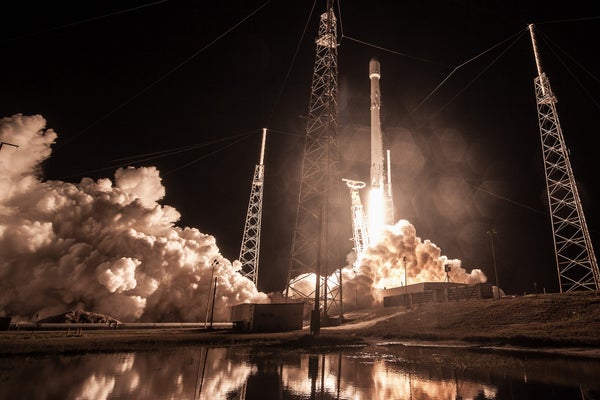
The U.S. government's hush-hush Zuma satellite may have run into some serious problems during or shortly after its Sunday (Jan. 7) launch, according to media reports.
Zuma lifted off atop a SpaceX Falcon 9 rocket from Florida's Cape Canaveral Air Force Station Sunday evening—a launch that also featured a successful landing back on Earth by the booster's first stage.
Everything seemed OK at the time. But on Monday (Jan. 8), rumors began percolating within the spaceflight community that something had happened to Zuma, Ars Technica reported.
On supporting science journalism
If you're enjoying this article, consider supporting our award-winning journalism by subscribing. By purchasing a subscription you are helping to ensure the future of impactful stories about the discoveries and ideas shaping our world today.
"According to one source, the payload fell back to Earth along with the spent upper stage of the Falcon 9 rocket," Ars Technica's Eric Berger wrote.
To be clear: There is no official word of any bad news, just some rumblings to that effect. And the rocket apparently did its job properly, SpaceX representatives said.
"We do not comment on missions of this nature, but as of right now, reviews of the data indicate Falcon 9 performed nominally," company spokesman James Gleeson told Space.com via email.
Space.com also reached out to representatives of aerospace company Northrop Grumman, which built Zuma for the U.S. government. "This is a classified mission. We cannot comment on classified missions," Northrop Grumman spokesman Lon Rains said via email.
Classified indeed. Pretty much all we know about Zuma is its vague destination—low-Earth orbit. It's unknown what the satellite will do, or even which government agency is charged with operating it.
If we hear anything else about Zuma's status, we'll let you know.
Zuma is widely regarded as a national-security mission. Before Sunday, SpaceX had launched just two national-security payloads—the NROL-76 satellite for the National Reconnaissance Office in May 2017 and the Air Force's robotic X-37B space plane this past September.
EDITOR'S RECOMMENDATIONS
In Photos: SpaceX Launches X-37B Space Plane, Lands Falcon 9 Rocket
In Photos: SpaceX Launches Koreasat-5A Satellite, Lands Falcon 9 Rocket
Copyright 2017 SPACE.com, a Purch company. All rights reserved. This material may not be published, broadcast, rewritten or redistributed.