
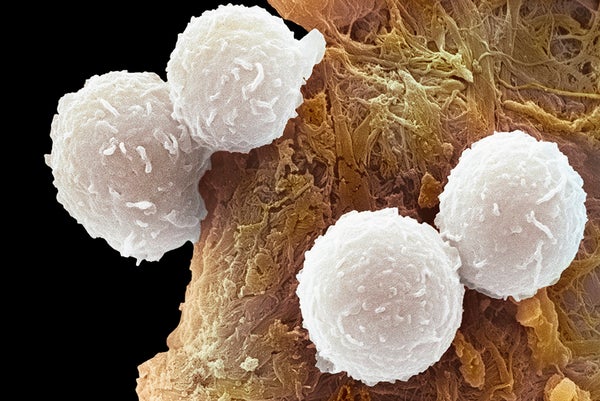
The Food and Drug Administration on Wednesday approved a promising new treatment for a particularly deadly form of cancer, bringing hope to desperate patients while rekindling a global conversation about the escalating cost of new therapies.
The treatment, made by Gilead Sciences, is made by extracting patients’ white blood cells and re-engineering them to home in on tumors. Called a CAR-T, the one-time treatment has shown unprecedented results for patients with dire diagnoses.
Gilead’s treatment, to be sold as Yescarta, is the second CAR-T to win FDA approval but the first cleared for use in adults. A similar therapy from Novartis, approved in August, is used for children with an aggressive form of blood cancer.
On supporting science journalism
If you're enjoying this article, consider supporting our award-winning journalism by subscribing. By purchasing a subscription you are helping to ensure the future of impactful stories about the discoveries and ideas shaping our world today.
Gilead’s therapy will cost $373,000 for a one-time dose, a price tag guaranteed to spur debate among insurers and public health officials. Novartis’ treatment, Kymriah, costs $475,000 per patient, a jarring price tag the company defended by pointing to the treatment’s never-before-seen benefits. Novartis also proposed a system in which Medicaid would only pay for the drug if patients respond within a month.
Gilead has not made a similar promise, and it might struggle to echo the same defense. One dose of Novartis’ therapy left 83 percent of patients cancer free after three months. For Gilead, whose treatment targets a different form of cancer, that number is just above one-third.
Gilead’s treatment is for the most common form of non-Hodgkin lymphoma, a particularly aggressive cancer called diffuse large B cell lymphoma, or DLBCL, which affects about 30,000 Americans each year.
Most DLBCL patients go into remission after treatment with the cancer drug Rituxan and chemotherapy, but about one-third either don’t respond to that regimen or eventually relapse. It’s these patients, who survive for only about six months on average, that Gilead’s treatment aims to help.
In a six-month trial on 101 patients, 36 percent saw their cancer completely disappear thanks to a single dose of Gilead’s therapy, and 82 percent had their tumors shrink by at least half.
But the treatment is not without risks. More than 40 percent of patients suffered anemia during the trial, and common side effects include a dangerous lowering of white blood cell counts and toxicity in the brain. Two patients in the study died of treatment-related complications.
Yescarta’s label will carry an FDA warning tied to an inflammatory storm called cytokine release syndrome, a reaction to CAR-T that can prove fatal in some patients but is commonly controlled with immunosuppressant drugs. Novartis’s therapy carries the same caution.
Embracing CAR-T is the first step in a major corporate evolution for Gilead, which paid roughly $12 billion for Kite Pharma to get its hands on Yescarta. The company made its name in the field of virology, first with combination treatments for HIV that helped change the standard of care, and then with a handful of drugs for hepatitis C that can cure nearly 100 percent of cases.
Gilead’s market valuation has risen about 9 percent since August, when it first disclosed its intention to buy Kite. The California drug maker is now worth more than $105 billion.
Republished with permission from STAT. This article originally appeared on October 19, 2017