
The quest to rejuvenate aging people with the blood of young donors has generated paying customers, captured the popular imagination, and, now, prompted a warning from the Food and Drug Administration.
The agency on Tuesday said in a statement that plasma infusions from young people provide “no proven clinical benefit” against normal aging, Alzheimer’s disease, or a host of other diseases—despite a surge in their promotion for those purposes. And, like any other plasma product, young-blood transfusions can pose risks, according to the FDA’s statement, which was attributed to Commissioner Scott Gottlieb and Peter Marks, the director of the agency’s Center for Biologics Evaluation and Research.
The FDA’s warning marked the sharpest rebuke to date of an industry that’s gained steam in the past few years even as mainstream scientists have urged caution.
On supporting science journalism
If you're enjoying this article, consider supporting our award-winning journalism by subscribing. By purchasing a subscription you are helping to ensure the future of impactful stories about the discoveries and ideas shaping our world today.
A startup called Ambrosia claims that it is now offering young-blood transfusions—at a cost of $8,000 for 1 liter of young blood, or $12,000 for 2 liters—in Los Angeles, San Francisco, Houston, Tampa, Fla., and Omaha, Neb., Business Insider reported last month. The entrepreneur behind that company, Jesse Karmazin, has yet to report the results of a clinical trial he ran testing the procedure, which involves an off-label use of an approved product. On Tuesday, however, following the release of the FDA statement, a notice on Ambrosia’s site said it would no longer offer the transfusions.
And last year, STAT reported on a gala event in West Palm Beach, Fla., meant to convince aging baby boomers to pay to enroll in a clinical trial testing another approach to young-blood transfusions.
The FDA’s warning did leave the door open to exploring young-blood transfusions within mainstream clinical trials, saying that that is the only context in which consumers should consider pursuing the therapy. For example, a biotech company called Alkahest is currently testing a plasma-derived product in Alzheimer’s patients; a previous study from the company yielded mixed results.
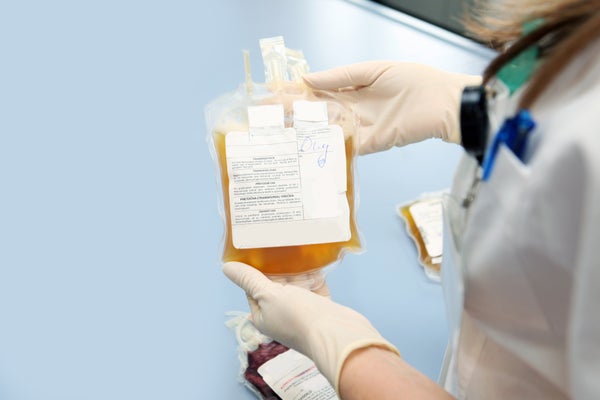
Young-blood transfusions typically involve plasma, the fluid part of blood packed with signaling proteins and other molecules but no red or white cells. Plasma from young donors is processed and sometimes filtered, and then infused intravenously into aging recipients, typically over multiple infusions.
The most research thus far into young-blood transfusions has been conducted in mice.
But while some of these mouse studies have been encouraging, other studies have been less so. And even when the data in mice look good, “nobody has actually shown over the long term how long these quote un-quote improvements persist, and we don’t know whether it’s broadly improving aspects of aging or it’s specific to certain tissues,” Matt Kaeberlein, a University of Washington biologist who studies aging in dogs and other animal models, told STAT last year.
Republished with permission from STAT. This article originally appeared on February 19, 2019