
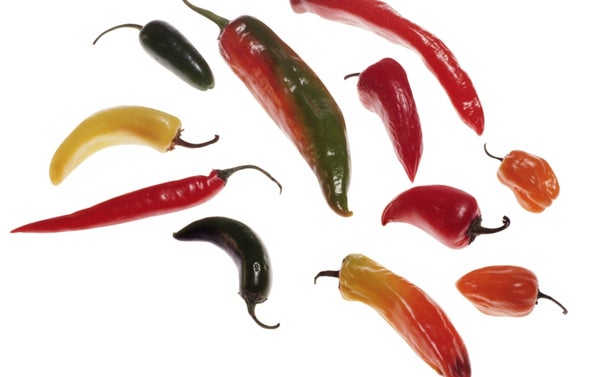
They have myriad shapes, flavors, colors and levels of spiciness, but all American chilies, chili peppers and bell peppers emerged from a single species that later led to three lineages.
Found in cuisines worldwide, chilies and peppers—name them as you wish—all belong to the Capsicum genus, which is native to America. And recent genetic studies confirm that they have a single common ancestor that emerged about 16.8 million years ago.
“Their origin is recent within the Solanaceae family, to which potatoes and tomatoes also belong,” says Mauro Grabiele, author of several genetic and chromosomal studies of 22 Capsicum species in preparation for his doctoral thesis. Now Grabiele is a researcher at the Institute of Subtropical Biology of the National Scientific and Technical Research Council (CONICET) in Buenos Aires and the National University of Misiones.
On supporting science journalism
If you're enjoying this article, consider supporting our award-winning journalism by subscribing. By purchasing a subscription you are helping to ensure the future of impactful stories about the discoveries and ideas shaping our world today.
His research also found three distinct groups that were established early during the Capsicum lineage’s evolution: Andean chilies with 26 chromosomes; another group from the coast of Brazil, also with 26 chromosomes; as well as 24-chromosome Andean chilies.
There are five species grown commercially: three subspecies of the complex Capsicum annuum (C. annuum, C. frutescens and C. chinense), along with C. baccatum and C. pubescens. All of them have a common origin and belong to the lineage of 24-chromosome Andean chilies. Of these, the best known commercial varieties are cayenne, jalapeño, tabasco and sweet peppers of the species C. annuum; rocoto and manzano peppers of C. pubescens; habaneros, panca and limo of C. chinense; and cristal, escabeche and green of C. baccatum, to name a few.
Grabiele explains that the wild species have the genetic potential to be crossed with the cultivated ones and gain some economically important qualities such as organoleptic properties (taste, color, spiciness) and resistance to drought and disease. “Particularly, wild C. chacoense and cultivated and wild species of the C. annuum and C. baccatum complex are able to interbreed giving fertile offspring,” Grabiele explains.
The same applies to C. pubescens and its wild C. eximium sister wild species. “However, the seven species of the 26 chromosomes wild chilies lineage from Brazil are a strong group for their particular chromosomal characteristics, plus there's a great temporal distance with the cultivated Andean peppers, which may be an impediment when sharing genes in a classic way,” he adds.
“Chilies present many challenges when growing them. Diseases and pests are always evolving, so new resistance genes must be found. In addition, with climate change, chilies should be cultivated with adaptations to the new climate,” says Paul Bosland, a chili expert and researcher at New Mexico State University. “Knowledge of individual chromosomes of each species will help the study of gene movement and hybridization between species, including the wild ones,” he adds.
So Spicy!
Although there are varieties that are not spicy, such as sweet peppers, spiciness and heat are the qualities most desired by chili eaters. “The hotness of chilies is caused by alkaloids known as capsaicinoids. They were developed to prevent mammals from eating the fruits and thus destroying the seeds in their digestive tract,” Bosland explains. This problem does not happen when birds eat the fruits, however, and they have helped spread the genre across America.
Although Grabiele did not focus his research on the spiciness, he discovered that C. rhomboideum, whichproduces fruits without spiciness, has very different chromosomes from the rest and a genome three times smaller. “This pepper, which is not hot, was separated early from the rest of peppers 15.6 million years ago, very close to the emerging of the genre. As all the other peppers have spicy fruit and share their last common ancestor 13.8 million years ago, that time would be the onset of spiciness for peppers,” he says.
According to Bosland, chilies could be one of the first crops domesticated in America because it dates back 10,000 years ago. “Associations of corn, peppers and ceramics were found in some regions of the continent showing that corn and chili occurred together as an ancient food complex,” he says.
Domestication occurred independently in different places for the five cultivated chili species. Current thinking suggests that C. annuum was first domesticated in Mexico. A study published in Proceedings of the National Academy of Sciences in 2014 determined that the origin of this species was in east-central Mexico, farther south than previously thought and in a different region from where corn and bean crops originated.
Meanwhile, C. frutescens was domesticated in Central America; C. chinense, in the Brazilian Amazon; C. baccatum, in Peru and C. pubescens in Bolivia. In Peru the oldest archaeological remains that prove their presence were found in Caral, thought to be the oldest civilization in the Americas.