
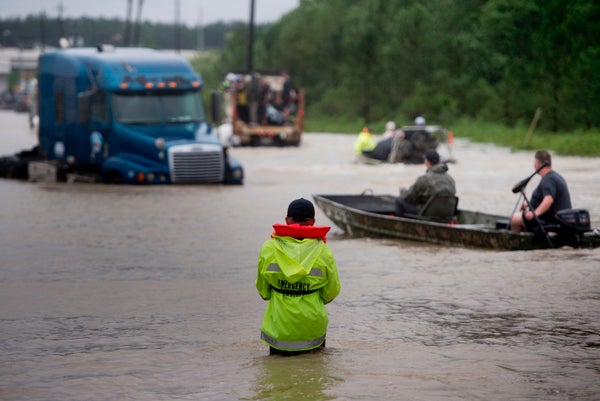
The first of what could be as many as 1,000 flood-destroyed Houston homes may soon be purchased and torn down as part of a sweeping program to move Hurricane Harvey victims out of the floodplain.
The Trump administration approved $25.6 million in Federal Emergency Management Agency hazard mitigation grants to Harris County, Texas, to avoid future property losses for tens of thousands of people whose homes line creeks and bayous that are subject to repetitive flooding.
Harris County Flood Control District officials made clear that the Houston home buyouts will be used to reduce flood damages “in areas hopelessly deep in the floodplain where structural projects to reduce flooding are not cost-effective and/or beneficial.”
On supporting science journalism
If you're enjoying this article, consider supporting our award-winning journalism by subscribing. By purchasing a subscription you are helping to ensure the future of impactful stories about the discoveries and ideas shaping our world today.
Authorities maintain that such homes should not be occupied, and government agencies have been racing to buy damaged properties before they are resold on the private market. All of the buyouts are voluntary, and owners are not obligated to sell to the government, officials said.
“These are homes at such high risk of flooding. People are in harm’s way,” buyout program manager James Wade told the Houston Chronicle last month after the newspaper published an investigative report showing how private investors were sweeping in to buy up at-risk properties.
In April, the Harris County district applied for $163.5 million in FEMA funds to purchase 1,000 homes considered to be at high risk of flood damage. FEMA responded with funding for the first round of buyouts in one month, a much faster turnaround than normal, officials said.
Also yesterday, the Texas General Land Office awarded $34.5 million in federal community development block grants to Harris County to initiate a buyout program for up to 160 repeatedly flooded homes.
The grants, funded through the U.S. Department of Housing and Urban Development, operate independently from the FEMA program.
Harris County officials have estimated that more than 200,000 Houston-area homes were damaged by floodwaters during Hurricane Harvey, which dumped nearly 50 inches of rain over the city and adjacent areas late last August. It was the most destructive Gulf Coast hurricane since Hurricane Katrina in 2005 and the most expensive storm since Superstorm Sandy in 2012.
The homes being bought out are scattered throughout Harris County. A spokeswoman for the flood control district could not provide exact locations where the planned buyouts will take place. But a map released by the agency shows concentrations of properties on the county’s north and east sides. Most of the homes lie in low areas drained by creeks within the San Jacinto River watershed.
To receive the initial $25.6 million in federal grants, Harris County had to provide matching funds of $8.6 million to initiate buyouts of the first 169 homes. The program will not begin until it gets final approval from a county court, which is expected to sign off on the program next Tuesday.
Harris County Administrative Judge Ed Emmett said in a statement that the county is “continuously working on our residents’ behalf to secure every avenue of federal, state, and even local funding available to move people out of harm’s way before the next storm or flooding event.”
The buyout homes were selected after being deemed “substantially damaged” by building code officials from Harris County or the city of Houston, officials said.
“Substantially damaged” means homeowners have limited options to bring homes back into compliance with current floodplain regulations, and the cost to repair the home is assumed to be equal to or more than 50 percent of the market value of the property.
According to National Flood Insurance Program data, Harris County had the highest number of properties—more than 3,000—that flooded during Hurricane Harvey and at least once before then.
Officials said the money will be spent “to prevent as many homes as possible from being rebuilt in harm’s way.”
Reprinted from Climatewire with permission from E&E News. E&E provides daily coverage of essential energy and environmental news at www.eenews.net.