
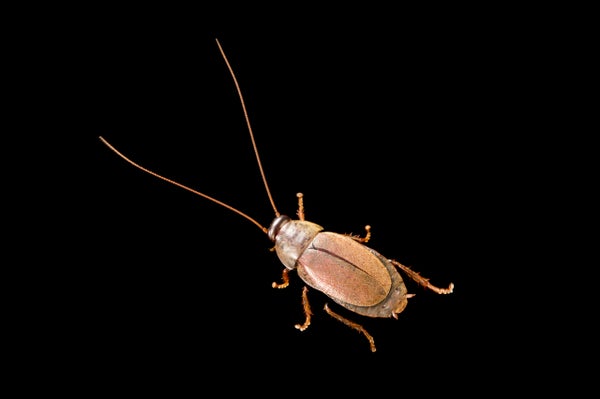
Humans are not the only species that deals with harassment. According to new research, female cockroaches may cluster together to keep male suitors at bay.
Christina Stanley, an animal behavior lecturer at the University of Chester in England, and her colleagues put Pacific beetle cockroaches in special containers to observe their social behavior. The roaches would gather in primarily female groups and jostle out the males. “Female [roaches] created this better social environment by excluding the males,” says Stanley, who led the study published online in July in Ethology. Because the females are much larger than the males, they “are more dominant, so they are more able to push the males out of the way,” she adds.
The researchers also ran an experiment with a higher ratio of male to female roaches. Under this condition, the females received more approaches and antenna investigations from males intent on mating. Thus, the females might flock as a strategy to deflect males' advances, Stanley says.
On supporting science journalism
If you're enjoying this article, consider supporting our award-winning journalism by subscribing. By purchasing a subscription you are helping to ensure the future of impactful stories about the discoveries and ideas shaping our world today.
Coby Schal, an entomology professor at North Carolina State University, who was not involved in the research, is unconvinced that the females were all trying to avoid male attention; he says the size difference between the sexes alone could account for the males getting kicked out.
But the changed behavior in the experiment with the excess males shows that more is at play, Stanley says. Also, female Pacific beetle roaches can store sperm from a single mating. Therefore, any further copulation would waste energy and could result in injury (not uncommon among roaches). Beyond brief time windows for initial encounters, the otherwise social females appear to have little use for males.