
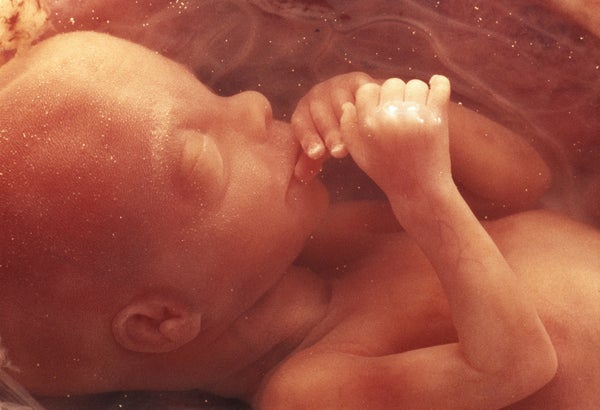
Fetuses favor patterns of light that resemble faces over those without face-like features, a new study suggests. The study, published last week in Current Biology, is the first to test visual processing in babies before birth.
The findings suggest that a preference for faces starts even before a baby has ever seen a face. And they run counter to the idea that babies like faces simply because that’s what they see first.
Gaining a better understanding of how face processing develops could help scientists better understand atypical development, including in the case of autism, says lead researcher Vincent Reid, professor of psychology at Lancaster University in the United Kingdom.
On supporting science journalism
If you're enjoying this article, consider supporting our award-winning journalism by subscribing. By purchasing a subscription you are helping to ensure the future of impactful stories about the discoveries and ideas shaping our world today.
“It could be that somebody’s early elements of visual processing are somehow not constructed correctly, which could then lead on to other forms of visual problems that you see in autism,” Reid says.
The work also has practical implications. Some children with autism avoid looking at people’s eyes and show an unusually weak brain response to images of faces. Scientists could look at the preferences of babies at high risk of autism while they are still in the womb.
“In principle, it could lead to the discovery of a very early developmental marker for risk for developing autism,” says Ralph Adolphs, professor of psychology and neuroscience at the California Institute of Technology, who was not involved with the study. Such a marker could help parents and clinicians decide on the best early therapies, he says.
Bright spot:
From the first hours of life, babies prefer to look at faces over other stimuli. But their vision is blurry at birth, so they don’t see the details of a face, just its general outline. Until several years ago, scientists thought the uterus was a dark environment. But the uterus is now thought to transmit light in amounts that a fetus can see.
In the new study, researchers used lasers to shine three bright dots through the uterine wall in 39 women in their third trimester of pregnancy. In one configuration, the dots formed an inverted triangle resembling two eyes and a mouth. In the other, the dots formed a triangle with one dot at the top and two at the bottom.
Reid and his team showed each fetus both dot patterns five times, moving the light across each woman’s abdomen for five seconds. They recorded the fetus’ reaction using 4-D ultrasound, which streams a video of 3-D scans. Fetuses were more than twice as likely to turn their heads toward the face-like pattern as toward the simple triangle.
The ability to track the visual response of a fetus represents “a methodological advance,” says Mark Johnson, director of the Centre for Brain and Cognitive Development at Birkbeck, University of London, who was not involved in the study. “It was known for quite a long time that we can study the auditory system of the fetus, see how they respond to speech and music, but it was assumed there was no point doing similar things with the visual system.”
The study also offers a way to extend work on infant vision to fetal development. It shows, Reid says, that “the fetus does not passively process the environment but actively responds to the environment.”
The researchers plan to extend the study to other areas of perception and cognition in fetuses. For example, they say, they would like to explore whether the fetus can discriminate between different numbers of dots.
Further Reading:
Doubt Greets Reports of Suramin’s Promise for Treating Autism
Parents’ Interactions with Infants May Alleviate Autism Features
This story was originally published on Spectrum.